Doris Mager, who 48 years ago famously lived for a week in a vacant bald eagle nest near Maitland to boost awareness of threats to the species, died in 2023 at age 98. But the aptly nicknamed “Eagle Lady’s” expansive and adventurous spirit soars over the Audubon Center for Birds of Prey.
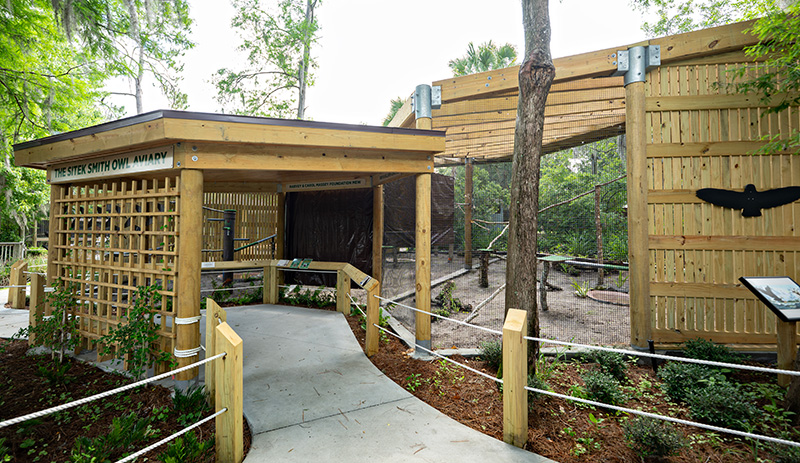
The center—which reopened to the public in February after a six-month, $675,000 project to build the new Sitek Smith Owl Aviary—treats between 600 and 800 sick, injured or orphaned raptors annually—and more than 200 of them are owls. It also shelters approximately 30 permanent residents whose injuries prevent their release into the wild.
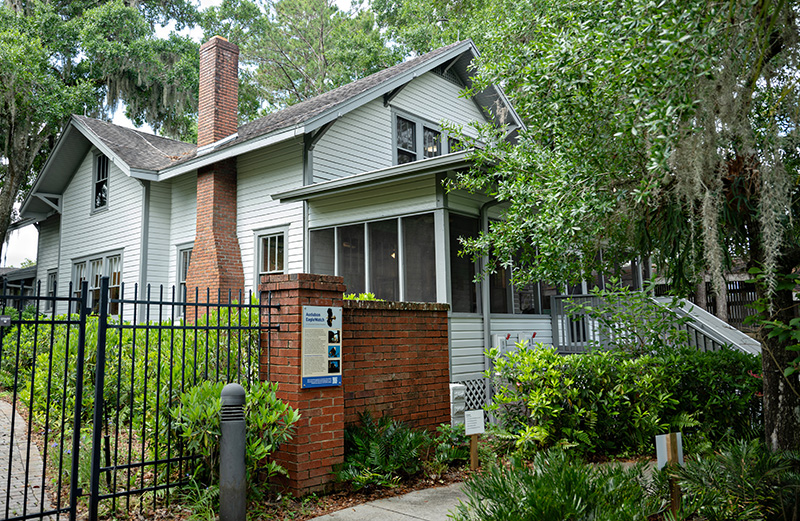
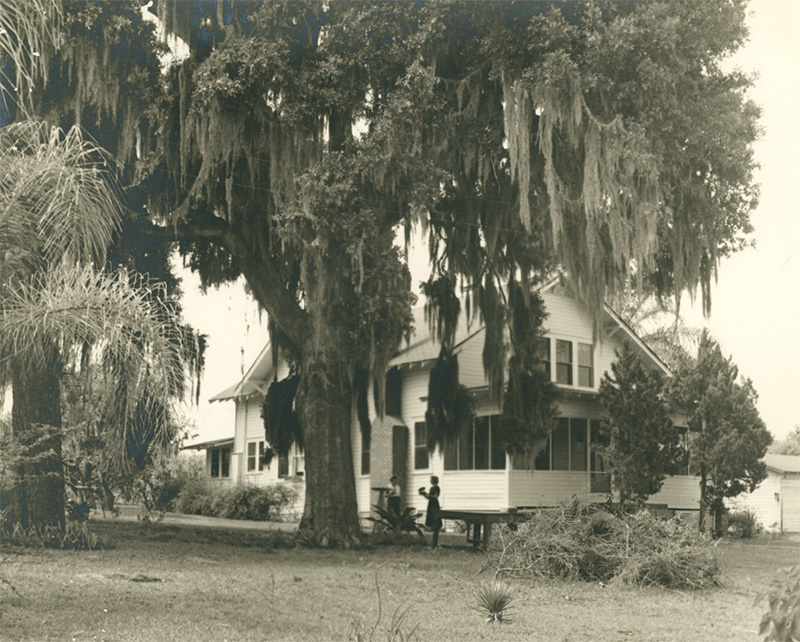
The property, located on three verdant acres that hug the southeast shore of Lake Sybelia in Maitland, was purchased by Audubon Florida (then the Florida Audubon Society) in 1959 using funds donated by benefactor Lisa von Borowski of Hernando County. It encompassed a gray, two-story bungalow built in the 1920s perfect for administrative offices, educational spaces and a gift shop.
There were, however, no facilities for the treatment and rehabilitation of injured birds, and no plans to start such a program. But the center’s mission began to evolve when Mager, who then managed the gift shop, started caring for winged creatures of all varieties that were brought in by members of the public. The first patient, in 1963, was a red-tailed hawk with an infected foot.
Mager, who had no formal veterinary training, took the ailing avian home and soaked its foot in Epsom salt and warm water. “My father had said, in life, use common sense and Epsom salt in everything,” Mager told Audubon magazine. “One month later that infection was gone and I knew it was time to let it go.”
Soon Mager became the community’s go-to (if non-credentialed) practitioner for birds of prey. She developed a particular interest in raptors and sought wisdom about their care from ornithologist mentors, including John N. Hamlet—a prominent naturalist, conservationist and co-author of the definitive 1964 book Birds of Prey of the World.
Hamlet had also established birds of prey exhibitions at such tourist attractions as Weeki Wachee Springs and opened his own attraction that featured falconry demonstrations and facilities for viewing raptors in Ocala. Mager eventually earned a rehabilitation permit from the U.S. Fish and Wildlife Service that licensed her to care for and house injured raptors.
Soon, though, Mager—who at one time kept as many as seven injured bald eagles in her yard—began bringing permanently disabled birds to work and incorporating them as ambassadors into her presentations at schools. Eventually, Mager and Audubon Florida agreed upon the need for a dedicated rehabilitation and education facility—and set about opening one on the property in Maitland.
Donations that resulted from Mager’s nationally publicized “eagle nest sit-in” and a gift from the family of Madalyn Baldwin, a recently deceased conservation advocate from St. Petersburg, helped to fund development of what was originally called the Madalyn Baldwin Center for Birds of Prey in 1979. The first structure was the original domed aviary.
Mager later became vice president of research and rehabilitation for Audubon Florida and, flying aboard single-engine planes, conducted pioneering surveys of the state’s bald eagle population. She resigned in 1983 to found her own nonprofit, Save Our American Raptors (SOAR), and crisscrossed the country in her camper van—birds in tow—to present programs at schools, libraries, wildlife centers and state parks.
“Doris really was the spark of life that moved Audubon Florida into the birds of prey rescue and rehabilitation business,” says the legendary Charles Lee, who for more than a half century has been director of advocacy for the organization, which was founded 100 years ago at the Maitland home of wealthy avian enthusiasts Louis and Clara Dommerich. “She started out in a very modest way, but the center that we have today is really the result of her pioneering work.”
By the late 1990s, the area around the headquarters building had become a full-fledged rehabilitation complex that encompassed multiple structures. Now, in addition to the home and the owl aviary, there are three other enclosures that may, at any given time, house bald eagles, falcons, kites, ospreys, vultures and falcons who stare inscrutably at visitors.
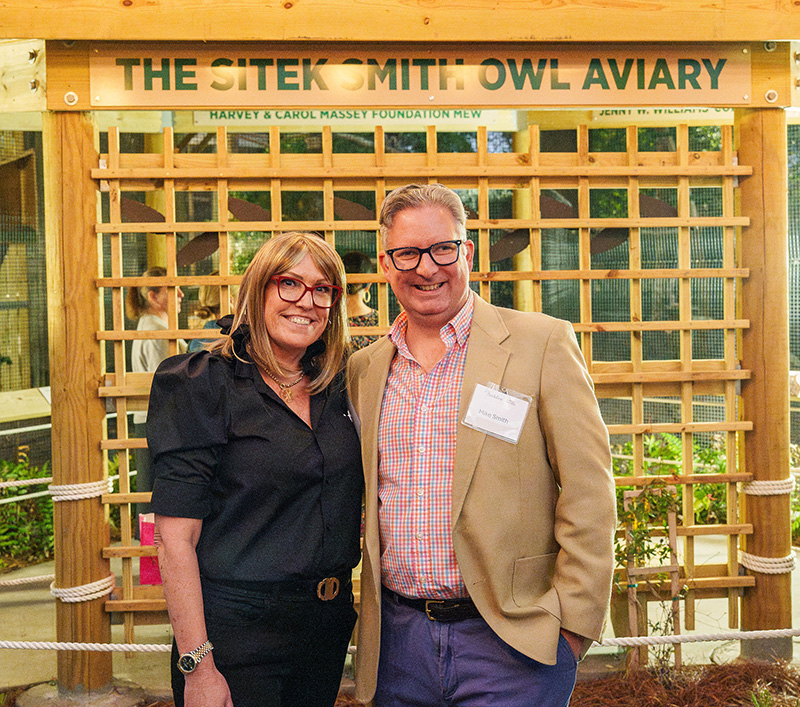
Eagles are majestic and even vultures have a certain creepy charm. But who doesn’t love owls? Thanks to the generosity of Winter Park residents Linda Sitek, a retired real estate agent, and her husband, Mike Smith, a semiretired architect, the allegedly wise (and certainly enigmatic) creatures have new digs.
Sitek and Smith became interested in owls about a decade ago when they rescued a pair of owlets that had tumbled out of their nest high in a backyard tree. They rushed the twin puffballs to the center, where they were nursed back to health and then returned to their home of sticks and twigs two weeks later.
“Mike and I watched them grow in the coming months,” says Sitek. “It was really just magical. The people at the center later gave us a behind-the-scenes tour and it really opened our eyes to the wonderful work they do and how dedicated the staff and the volunteers are.”
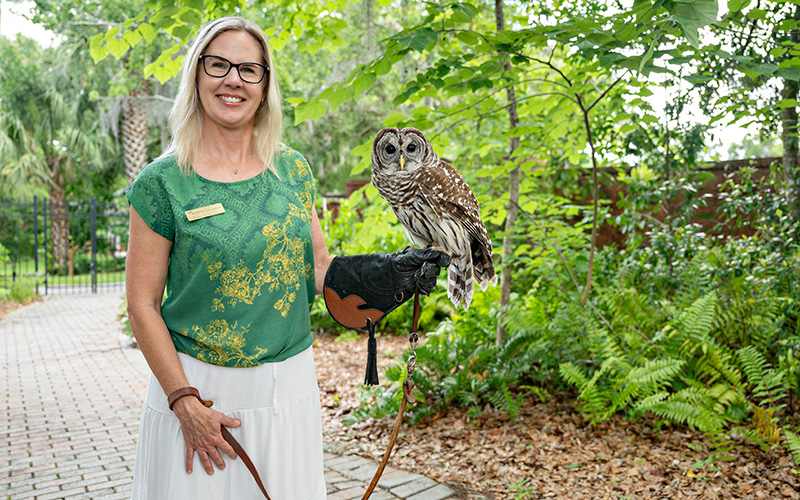
Today, the aviary’s full-time residents include two barred owls, Fil and Hitch, and three great horned owls, Henry, Charley and Jeanne. “It made us so happy to see how happy the owls were,” says Sitek, who now serves on the center and the state boards and last year was named Philanthropist of the Year by Audubon Florida. “They were just hooting away.”
Also on campus is a lovely gazebo overlooking the lake, a “Magic of Flight” barn for birds currently undergoing rehabilitation, a butterfly garden and a man-made wetlands area—all connected by shady paved walking paths with informative (and recently refreshed) signage. Indoor exhibitions highlight such topics as conservation and climate change.
While public areas were closed to visitors, the freestanding Raptor Trauma Clinic—which is staffed by a team of wildlife rehabilitators and veterinary technicians—remained open for business to help birds who had fallen from nests, collided with cars or buildings, become entangled in fishing wire or been sickened by toxins and disease.
The clinic includes a lab for bloodwork to assess organ function as well as radiography equipment to detect broken bones and ingested foreign objects. Veterinarians from the Winter Park Veterinary Hospital typically oversee more complex cases and perform surgeries off site.
As birds are stabilized, they are transferred to the center’s rehab area with the goal of releasing them when they’re ready. “We have about a 40 percent release rate, which is good for a facility our size,” says Katie Gill Warner, the center’s longtime director, who is a graduate of the University of Alabama with a degree in biology. “Each bird that we’re able to release contributes to conservation of these special species.”
Adds Warner, who this year celebrated her 25th anniversary with Audubon Florida: “Our most intense time in the clinic is during baby season, which starts about March and lasts through the end of July. We get 20 percent of our annual patient load just in May, which equates to around 100 birds needing care—so it gets kind of crazy.” (The term “baby season” refers to the peak of the nesting cycle for raptors in Florida.)
The Audubon Center for Birds of Prey, with a full-time staff of eight and hundreds of volunteers, is truly an under-the-radar treasure—not only for its importance to bird life but also for its educational programs that include internships, youth camps, and presentations for schools and civic groups.
Plus, it’s a terrific place to while away an afternoon, get up close and personal with some birds who would otherwise be unapproachable and revel in the subtropical ambiance of natural Florida. The center draws a relatively modest 13,000 visitors per year, so it’s rarely crowded and always relaxing.
Best of all, you can feel good about supporting a worthy cause and perhaps even get motivated to volunteer. The center relies on community support and is funded by foundations, corporations and individuals
The campus is located at 1101 Audubon Way, Maitland. Its hours are Tuesday to Sunday, 10 a.m. to 4 p.m., and admission is just $10 (children under age 3 are admitted free). Tickets can by bought in advance online or at the facility’s ticket window. For more information, call 407-644-0190 or visit audubon.org/cbop.