
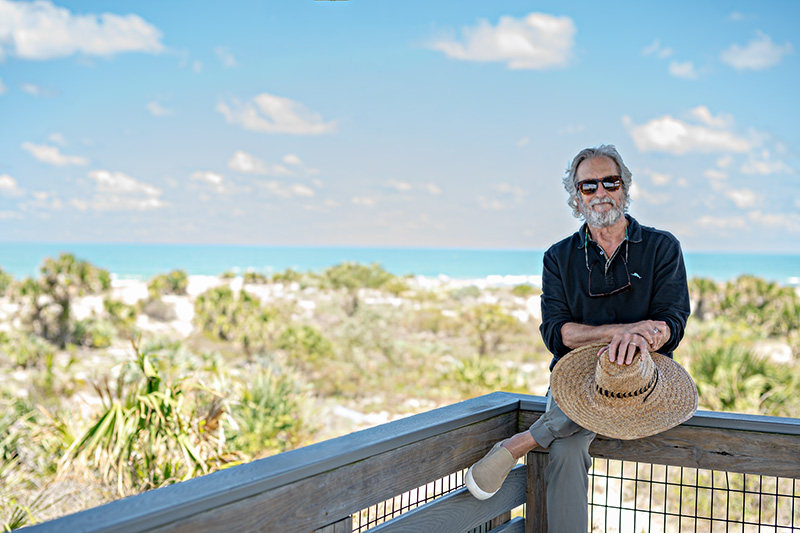
It’s just after daybreak and I’m passing the quarter-mile marker on the loop boardwalk at Smyrna Dunes Park. I’m walking counterclockwise, the best way to go. Because that’s where you hit the incline—a pretty steep incline, for Florida anyway, just past the stretch where you might spot painted buntings in the wax myrtles when it’s spring and where you can almost always see gopher tortoises nosing out of their holes.
And when you reach the top …
To the east there’s the aforementioned daybreak over the Atlantic, quite often spectacular, and on middling mornings merely awesome. There’s a decent swell today, with surfers dotting the water south of the jetty, reading waves. Some days it’s blown out, all seafoam and treachery, other days flat as a flounder.
But standing here, looking out, it’s always uplifting. The entrances haven’t opened to cars yet so the beach is empty except for the walkers, the sandpipers and the seagulls. To the north—Ponce Inlet. Some historians say it was here, not St. Augustine, where Ponce de Leon first sighted La Florida and touched land. It’s a narrow cut, unpredictable.
Once, years ago, coming back from an offshore regatta on a friend’s sailboat, a sudden squall swept in, 40 mph gusts out of nowhere, an accidental jibe, and we lost our mast. I went overboard, instantly terrified by the specter of the infamous Ponce sharks. (This is, after all, the Shark Bite Capital of the World!). But then came the calm of knowing: “It’s not my boat, and I probably won’t die.”
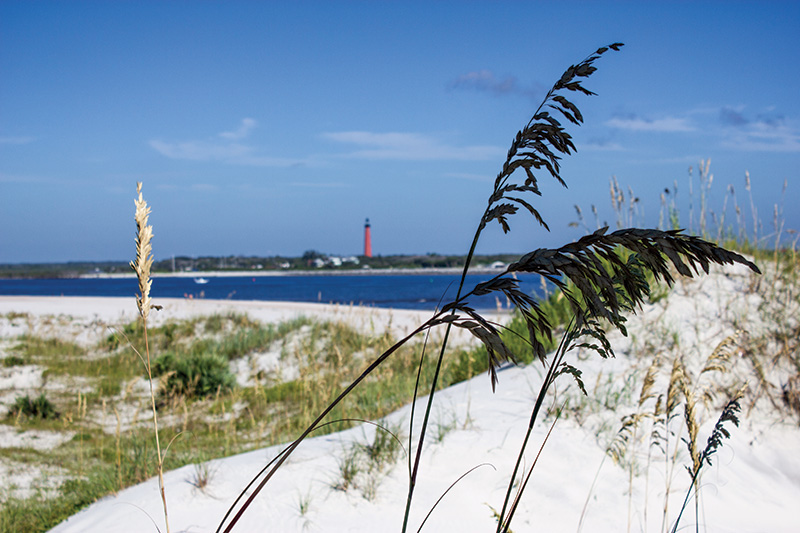
Beyond the inlet, the armored shoreline of Daytona Beach, is somewhat tempered by the red-brick sentry that is Ponce Lighthouse. At 175 feet, it’s the tallest lighthouse in Florida and the third tallest in the United States. Its light was first lit in 1886.
I can never look at this towering sentinel without thinking about what was once, for some daring and libidinous young souls, a Central Florida rite of passage and I hope still is: Getting a friend to watch the stairway while you scurried to the top with your paramour du jour to, you know, enjoy the view in extremely amorous fashion. You’ve heard of the Mile-High Club? This was the Lighthouse Club, quite exclusive in its day.
To the west—the Intracoastal Waterway, broad sandbars and mangroves, and Disappearing Island. In a couple of hours, it and other nearby spoil islands will host a flotilla of boats, picnics and families with dogs. My younger son and his family have a place in New Smyrna. If their pontoon boat cranks, always iffy, we plan to be out there, too.
Winter Parkers Everywhere
I’m among the legions of Winter Parkers who have one foot in our city and the other in New Smyrna Beach. We’re everywhere over here. Go shopping at the beachside Publix and it’s practically guaranteed that you’ll bump into someone you know. Same thing at restaurants and bars.
I recently clicked on Google Maps to see how New Smyrna shows up in the geographic scheme of things. And I was surprised by what I found. Zoom into the area around Smyrna Dunes Park and the U.S. Coast Guard Station and you’ll see that it’s labeled, not New Smyrna Beach, but … Orlando Beach.
This is not an official designation, of course, but one that reflects the demographics of who hangs out here. Cocoa Beach might be a few miles closer, but New Smyrna is where we go. Over the years, this has rankled some beach locals. Graffiti has occasionally appeared saying: “O-villes go home.” While this might be directed at Winter Park’s neighbors in Orlando, it still stings by proximity.
“The O-ville-go-home thing got started with the surf culture, which can be pretty territorial,” says Steve McCarthy, a former Winter Parker who moved full time to New Smyrna several years ago with his wife, Krystal. “It’s not as bad as it used to be, except maybe at the inlet when there’s a good swell. Despite how much it’s grown, New Smyrna is still just a little surf town.”
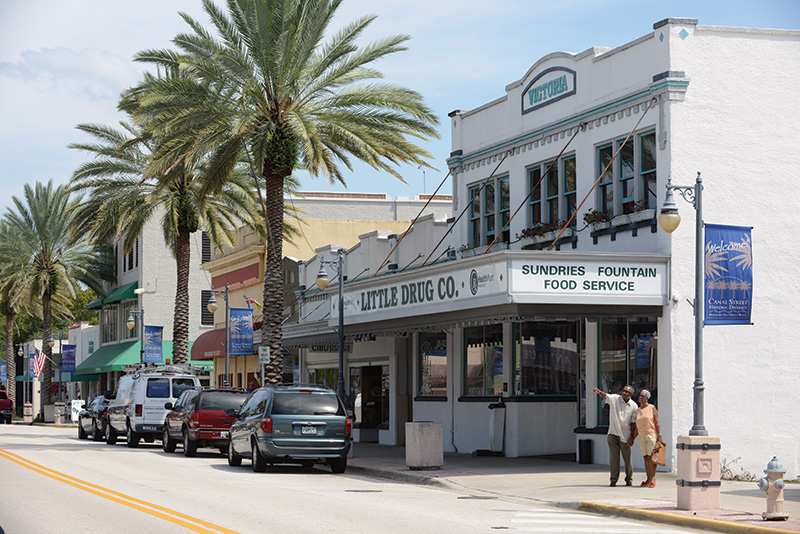
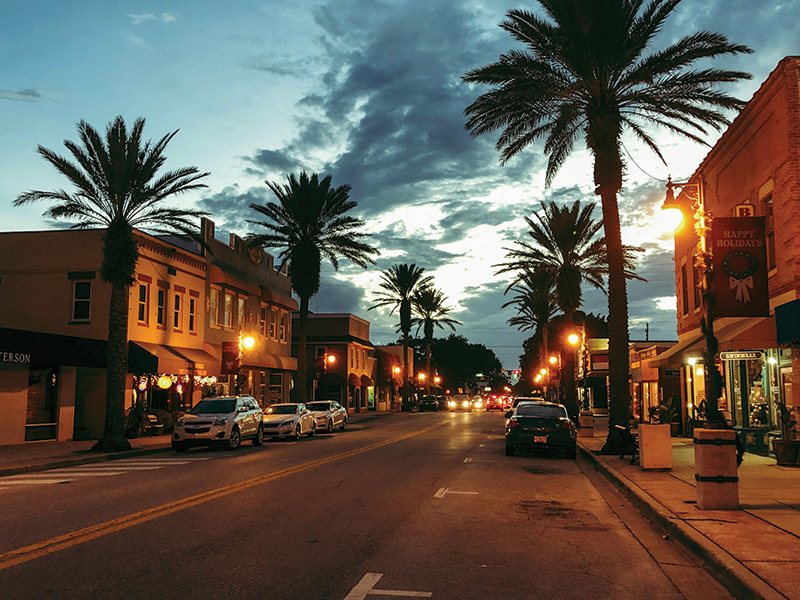
Make that two towns, which is a large part of the charm. There’s the beachside downtown along Flagler Avenue that, for better or worse, has developed a Key West/Duval Street vibe, especially during Bike Week. And there’s the mainland downtown along Canal Street, which is bit more staid and buttoned down.
But back to Winter Parkers and our prevalence here. The Rev. Jim Spencer, formerly of All Saints Episcopal Church in Winter Park and chaplain at Trinity Prep, moved to New Smyrna in the late 1990s with his wife, Sally, to serve as rector at St. Peter the Fisherman Church.
After his retirement, Spencer, better known as “Father Jim,” founded Barnabas Ministries of Central Florida. The nonprofit organization connects people in need with resources to help them. It has also been instrumental in its work with the Mary S. Harrell Black Heritage Museum and the local Boys & Girls Club.
“New Smyrna has always been a wonderful place to call home. And it’s fair to say that the generosity and the support of folks from Winter Park have helped make it an even better place,” says Spencer. “People from Winter Park don’t just come over here to enjoy themselves. They get involved—they give back.”
Case in point: Hal George, a Winter Park custom-home builder (Parkland Homes) and founder/president of Habitat for Humanity of Winter Park/Maitland. George first visited New Smyrna back in 1972, when he came to Florida from his hometown of Virginia Beach to take part in a surfing competition. He had plans to attend Duke University on a lacrosse scholarship, but that visit changed his course.
“I decided to go to Rollins College mostly because it was just an hour’s drive to Ponce Inlet and good surfing,” says George. With his wife, Teresa, George has had a second home in New Smyrna since the 1990s and has been involved with various projects to better the community. “We escape to New Smyrna every chance we get. It’s our refuge.”
It’s the same for me and our family. I’ve been coming to New Smyrna since I was a kid. More memories than I have space here to mention. My father taught me to fish on Mosquito Lagoon, dragging me out of bed at 4 a.m. so we could put in at Oak Hill before sunrise and be done mid-morning before it got too hot. Memory tends to embellish when it comes to fishing, but it seemed we always loaded the boat with reds and trout.
Our sons learned to surf here. Probably learned some other things here, too, as Winter Park teens tend to do. My wife and I have logged countless miles in beach walks and, in season between May and October, counted loggerhead nests by the score.
Lightning and Loggerheads
One summer, when the boys and some of their friends were young, we got a whiffleball game going on the beach using clumps of seaweed for the bases. I was at bat when Bo, our older son, shouted: “Hey, Dad! There are turtles coming out of second base!”
A procession of 50 to 60 hatchlings streamed out of the sand and we escorted them to the water, watching them swim away. Loggerheads can live 70 or 80 years. So, I like to think that some of our whiffleball turtles have survived and they and their progeny return to New Smyrna to lay their eggs.
There’s good news on that front. The 2025 nesting season on Volusia County beaches shattered all previous records, with 3,908 recorded nests, mostly loggerheads, but with a fair number of leatherbacks, greens and Ridleys. That’s nearly double the number in previous years.
This being Florida, thunderstorms can be a daily occurrence at New Smyrna. They’re magnificent to behold as they build up in the sky, but they can sneak up on you. One summer, we were sitting on the beach, not paying attention to the weather, when we heard a rumble to the west and turned to see the towering dark clouds rolling in.
We gathered the chairs and coolers and umbrellas and hightailed it across the sand dunes to the house where we were staying. Lightning flashed all around. The rain came pounding down. Things getting really hairy.
The screen windows in the living room were wide open and, as I grabbed the metal frame to close them, I watched, frozen, as lightning struck the transformer on the utility pole in the driveway, jumped to the house, and next thing I knew I was flat on my back on the floor with scorch marks on the palms of my hands.
My wide-eyed sons looked down at me. “That was pretty cool,” said one of the little bastards.
I survived to write the better part of five novels holed up in that same house on Beacon Street. While those novels play out in various parts of the Caribbean, the main character, Zack Chasteen, lives in a place modeled after New Smyrna. I called it Minorca Beach, homage to the 1,200 indentured workers from the Spanish island of Minorca who arrived here in 1768 to found an agricultural community under the leadership Dr. Andrew Turnbull, a physician from Scotland.
They built a fort in what is now downtown New Smyrna atop shell middens left by previous residents, the indigenous Timucuans whose line died out in the early 1700s. Things didn’t work out much better for the Minorcans. Over the next nine years, more than 1,000 of them died. The rest said to heck with it and marched north to start over in St. Augustine.
While some descendants of those settlers have returned to New Smyrna in the years since, the most notable and ironic nod to the legacy is the Minorca Condominiums, more than 300 units near the north tip of New Smyrna. Original plans called for the development to stretch all the way to Ponce Inlet, continuing the march of condos down the coast from Daytona.
But local government leaders like New Smyrna attorney Clay Henderson, a former Volusia County Council member and president of Audubon Florida, stepped up to halt those plans and set out to preserve swaths of green space around New Smyrna.
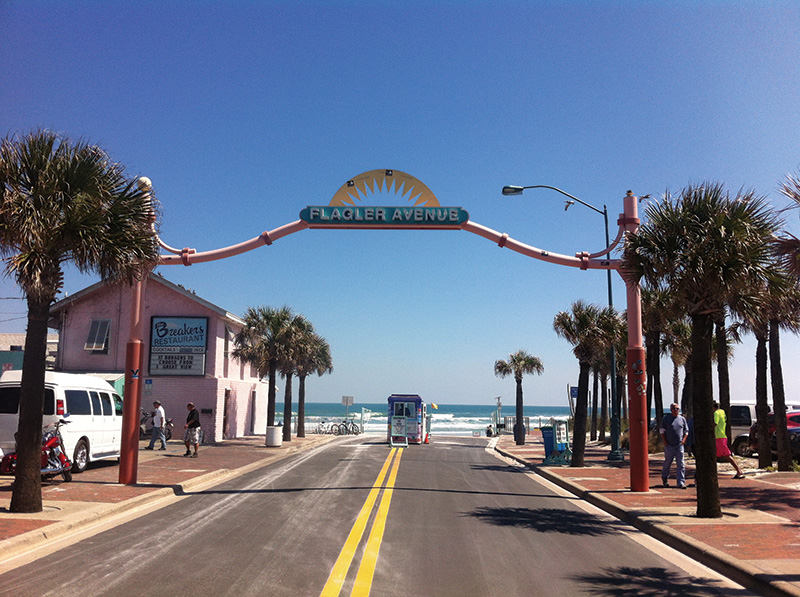
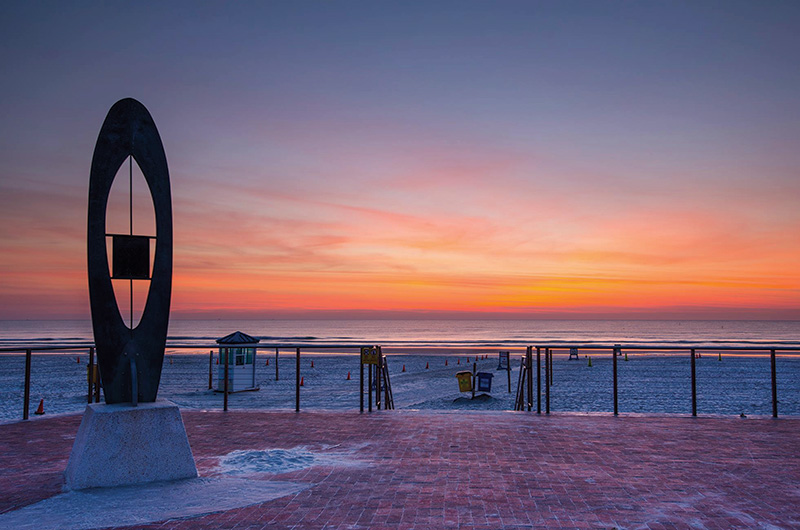
Creating a Green Donut
“If you want to see an example of what land conservation efforts could have done for the rest of Florida, you need look no further than what organizations like Florida Forever and Preservation 2000 did here,” says Dykes Everett. He’s a Winter Park attorney and founder of Dykes Everett Co., a land natural resources adviser/consultant. “I like to think of it as the ‘green donut’ that surrounds New Smyrna.”
Everett grew up in Mims, a few miles south on U.S. 1. He has been coming to New Smyrna since he was a kid and, with his wife, Lisa, has a second home here. He remembers camping with his family at Bethune Beach and, on the drive back to Mims, picking up smoked mullet wrapped in newspaper at Norwood’s Restaurant, which traces its roots back to 1929 when it was the only gas station on the beachside.
“The aroma of that smoked mullet was torture because our parents wouldn’t let us eat it until we got home,” says Everett, a dedicated angler who keeps a boat in the water near Ponce Inlet. “New Smyrna has changed drastically since I was a boy. But it has somehow managed to keep its soul. It’s where we come to escape the insanity that is too often the rest of Florida.”
On this particular morning, it’s hard to pull myself away from this crest on the boardwalk at Smyrna Dunes Park. It’s a view unequaled in all of Florida; the morning breeze and the good salt air getting me right for the day. Maybe I’ll take a dip in the ocean, maybe not. Later, a nap might be in the offing. We’ll grill out, watch boats on the waterway and fisherfolk cleaning their catch at the marina.
Then we’ll soak up the sunset. It’s most always spectacular, too. And I tell myself: There are few places in this world I’d rather be.
Bob Morris is the president of Story Farm, a Winter Park-based custom publishing company, and the author of five novels set in Florida and the Caribbean. You can find him on Substack at Bob’s Diner (bobmorris.substack.com).
An Ocean Escape For a Dollar Bill
Remembering Pelican House, which students loved, housemothers hated.
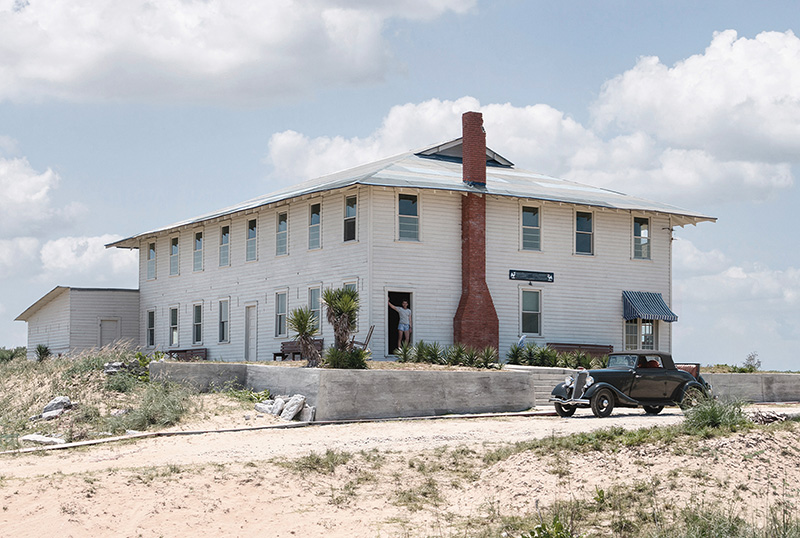
When a president declares Fox Day at Rollins College, many students take advantage of the impromptu holiday and head for New Smyrna Beach. It’s a tradition that dates back more than 90 years—to a time when the college owned a rambling retreat called Pelican House.
The two-story frame structure was built in the early 1920s by the Presbyterian Church USA as a conference center, and was shortly thereafter sold to retired Penn State Professor of American Literature Fred Lewis Pattee and his first wife, Anna Laura Plumer, who converted it into—of all things, for a former church facility—a casino.
Anna, however, died in 1927, and the casino went bust later that year. So Pattee and his second wife, Grace Gorrell Garee, gifted the property to Rollins. Pattee also came out of retirement and joined the faculty at Rollins. Pelican House was initially used by the college to host off-campus seminars as an extension of President Hamilton Holt’s innovative, lecture-averse “Conference Plan.”
During World War II, Holt leased the property—which was located on a desolate and undeveloped stretch among the dunes of south beach—to the U.S. Coast Guard to serve as a defense station. Service members mostly conducted “sand pounding” security patrols to watch for Nazi saboteurs, shipwrecks or enemy vessels trying to approach the shore.
Following the war, in 1944, Pelican House became a recreational facility where as many as 40 students at a time could enjoy budget beach getaways (just $1 per weekend) provided they brought their own linens and food. A succession of live-in housemothers maintained strict rules—or, at least, they tried to—with men stationed on the first floor, women on the second.
But college kids will be college kids, and policing hanky-panky clearly wasn’t an easy job. By 1968 the last housemother had resigned (breaking her contract to do so, according to college historians) and no one could be found to replace her. Pelican House, after standing vacant for two years, fell into disrepair and was routinely vandalized.
Despite student protests, the college’s board of trustees voted to sell the increasingly valuable oceanfront property in 1970 for $150,000. The house was demolished and the tract today encompasses the Pelican Condominiums, a 150-unit development along what is now Atlantic Avenue.
Rollins students still flock to New Smyrna Beach, of course, but they now do so on their own. For a time, the college’s Student Government Association hired charter busses to ferry students to the beach on Fox Day—but halted the practice in 2012 due to what was described as “safety concerns.”
—Randy Noles