
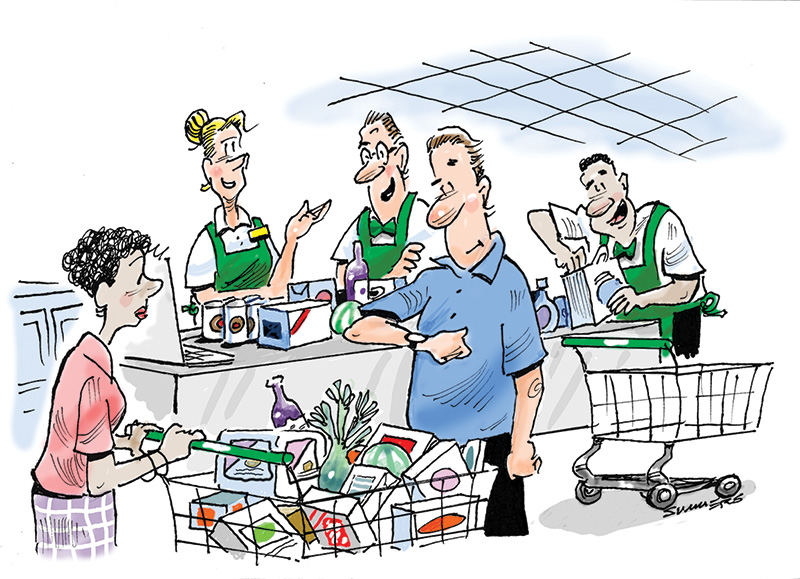
Rhythmically sliding my items through security to the bagger, the Publix cashier looks up and cheerily inquires: “Do you have any plans for the weekend?”
I freeze. It’s not just the cashier listening for my answer—a peek into my personal business—it’s the bagger and eavesdropping shoppers behind me. I’ve been getting this question more lately and I still respond like a deer in headlights.
Do I tell the truth? “Probably just sleep late, wash the dog, reorganize the spice rack, order DoorDash, binge Law & Order reruns and fall asleep on the couch.” Too sad.
Do I lie? “We’re going to New York for a play on Broadway, lunch at Tavern on the Green, Itzhak Perlman at Carnegie Hall and dinner at The Russian Tea Room.” Too tony for a guy in cargo shorts and a “FLORIDA MAN” T-shirt.
Do I really look like someone with plans for the weekend? Or someone still recovering from last weekend? Despite risking another zombie moment prompted by a well-meaning but overreaching clerk, I keep coming back to Publix for more. Why? It’s not the BOGOs.
At a time when life on social media and the street can feel rude, crude and impersonal, I’ve come to value oases of endorphins—at the Ace Hardware and Mediterranean take-out down the block or the Walgreens where a certain clerk always asks about my wife. Mostly, though, it’s Publix where I spend the bulk of my retail time.
Publix is a cross between a Hallmark movie and The Twilight Zone. I enter my neighborhood supermarket to “good morning!” from an unseen voice. Bonhomie fills the air like incense. There’s a cult-like quality to the helpfulness. Ask where I can find the wasabi sauce and a green-aproned worker drops everything to escort me to Aisle 4. I like it!
It turns out I’m not the only one who ponders the nature of fleeting communication with people whom I don’t know. Josh Hammonds studies stuff like this as professor of communication in the Roy E. Crummer Graduate School of Business at Rollins College.
I told him about my deer-in-the-headlights moment and he said it was a classic case of “Expectancy Violation Theory.” Explained Hammonds: “We go around with a prewritten script about the way people are going to act. When someone violates that expectation, it causes arousal in the brain, positive or negative.”
In some cases very negative.
I always figured self-checkout is simply an option for people in a hurry when lines are long at the registers. I was startled to discover online a small universe of shoppers who use it strictly to avoid cashier chitchat. Here are some examples:
“That’s why I use self-checkout. Cashiers ask me what my plans are while I’m buying my sad stuff. No thank you!”
“I find it annoying when they scan my groceries and make remarks like, ‘Wow! This tea looks delicious; it must be a new flavor’ or, ‘Oh my god! I didn’t know there was such a thing as Twinkie ice cream!’”
“Please don’t ask me, ‘How is your family?’ That is the job of my barber.”
“It’s stupid and wastes everybody’s time. My favorite cashiers are the ones who don’t make small talk and leave me the hell alone. I don’t know anyone who genuinely enjoys it.”
They don’t know Josh Hammonds. “When a clerk says something totally unexpected—an offbeat question, a random observation—it genuinely makes my day,” he says. “I’m probably the one keeping the clerk talking longer than they expected.”
Continues Hammonds: “A clerk will spot something in your cart and really want to know how you’ve been preparing it at home. Next thing you know, you’re deep in a whole conversation about cauliflower gnocchi.”
He gushes about Dutch Bros Coffee, where a teenaged employee complimented his wife—”a 44-year-old woman!”—on the blouse she was wearing. And there was a kid at Raising Cane’s Chicken Fingers who crowed “cool!” over the red-and-black interior of his car. Hammonds is not annoyed but impressed: “Here’s this 16-year-old trained to reach out to me, this 45-year-old guy.”
Granted, a convivial sort of guy like Hammonds, who admits to being “pretty interpersonal by nature,” has a higher threshold for schmoozing than introverts, “who don’t want anyone talking to them,” says Winter Park psychologist Deborah Day.
Day advises those uncomfortable with checkout palaver to “say nothing.” If that feels too Fifth Amendment-ish, try “I’m not doing anything special, just spending time with my family.” (Which sounds like a disgraced politician resigning from office, but I digress.)
When Day herself wants to politely deflect cash-
ier blah-blah—such as “How’s your evening going?”—she keeps it simple: “Fine. And how’s your evening going?” She even has a clever tag for such arms-length exchanges: “Interaction Lite.”
Of course, it’s possible to entirely bypass the conveyor belt inquisition by having your groceries delivered, a common option in the 1930s and ’40s when it was done by a neighbor kid on a bike with a basket attached to the handlebars.
Computers and the internet facilitated home delivery as we know it today. Both Walmart and Publix pilot-tested the idea before offering same-day delivery of fresh foods circa 2017—just in time for COVID-19. Online grocery sales during the pandemic were reported to have surged by more than 100%—and growth has continued apace during 2026.
Surging at the same time, however, has been loneliness, which was declared a national epidemic in 2023 by then-U.S. Surgeon General Dr. Vivek Murthy, who asserted that social isolation poses health risks as deadly as smoking a dozen cigarettes a day. A new survey by the research firm Science of People found that 58% of Americans “feel invisible.”
Those who feel a need to be seen can always visit Publix, where no one stays invisible for long. Green-aproned sentries seem to keep watch and appear magically, like friendly ghosts, when a solitary shopper seems to be paralyzed in the aisles in search of toothpicks and pumpkin puree.
Hammonds believes that we’re slowly emerging from a protracted lockdown funk. He notes an uptick in watch parties—not just the Super Bowl but TV shows like White Lotus, Love Island and The Bachelorette.
“I think the pendulum is swinging back,” he says. “We realized that in isolation that we were literally wasting away. We need to laugh with people. We want the human ‘sidebar’ as much as the show itself. We’ve been in the dark so long. We’re just now coming back into the light.”
So, do I have any plans for the weekend? I can’t lie. Nothing special. I may drop by Publix for a few items and a bit of Interaction Lite with a stocker in dairy or produce. At checkout, if I find myself behind Hammonds and I’m in a hurry—no offense, professor—I may opt for self-checkout.
Greg Dawson is a journalist and author. He has worked as a reporter, a television critic, an opinion columnist and a consumer columnist. His most recent book, with Susan Hood, is Alias Anna: A True Story of Outwitting the Nazis (HarperCollins, 2022). Dawson is a contributing writer for Winter Park Magazine.