
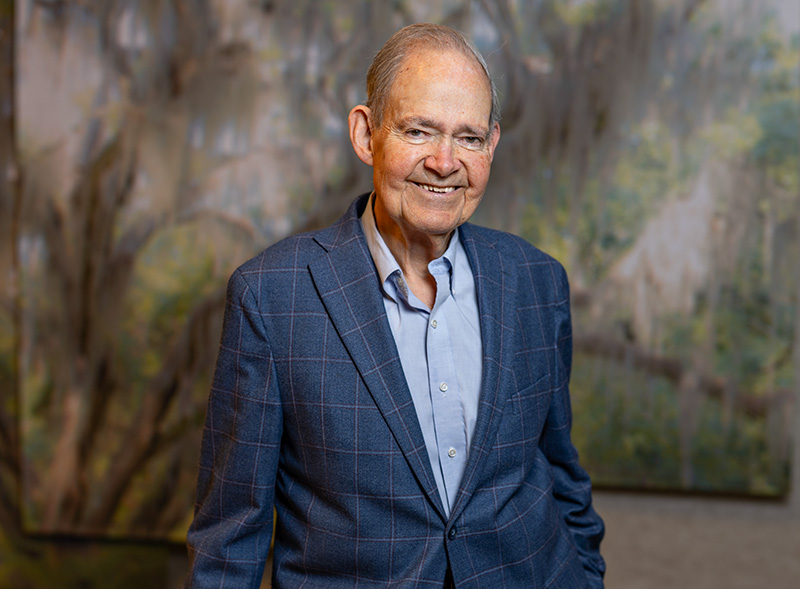
When Harold A. Ward III died in late March at age 92, numerous obituaries referred to him as “the city’s iconic father figure.” Actually, Winter Park Magazine first used that term to describe him in 2025, when we named the respected and beloved community leader one of Winter Park’s 10 “All-Time Influentials.”
The mighty but modest partner at Winderweedle, Haines, Ward & Woodman—always first and foremost a family man devoted to Libby, his wife of 66 years who predeceased him, and their children—was certainly influential. But he was also important in ways that transcended professional achievements.
Harold was the living embodiment of the city’s spirit, with generational family connections that dated back to the 1880s. He was a powerhouse attorney who, as a young man, had clerked for U.S. Supreme Court Justice Hugo Black—a staunch First Amendment absolutist appointed to the bench by Franklin D. Roosevelt.
Indeed, Harold might one day have become a federal judge or even a member of the high court himself. But he chose to practice law in his decidedly under-the-radar hometown—where he could make a more direct impact on the community he loved—instead of hitching his star to the high-powered D.C. firm that had recruited him.
Thank goodness for us. Here, Harold would become a foundational force behind many of the city’s most important charitable causes, a painstaking protector of philanthropic legacies, and a clear-eyed counselor to both his clients and community organizations of every variety. He was regarded as a gentle giant who exemplified honesty and sound judgment.
Many of us have listened to proposals regarding some civic matter and reflexively thought: “Well, we should run that by Harold.” Not that such consultations were required. It’s just that being a pillar of the community brought with it certain obligations that Harold patiently accepted—among them giving pro bono advice when it was sought, which was pretty much all of the time.
After all, Winter Park was his ancestral home. First here was Harold’s great-grandfather, Charles H. Ward, a citrus grower who had moved to the settlement of Osceola (now Winter Park) from New England. Among the Ward family patriarch’s accomplishments: developing a freshwater pumping system that supplied irrigation for his trees and those of his neighbors.
Later, Harold’s grandfather, Harold A. “Harley” Ward, headed the Winter Park Land Company for Charles Hosmer Morse—without question the city’s most important benefactor—and served as the city’s mayor, as did Harold’s great-uncle, Fred C. Ward, several years later.
Harold’s father, Harold A. Ward, was also a prominent resident and citrus grower who was civically active and, like virtually everyone in the Ward family since 1886, was a member of the First Congregational Church of Winter Park. Indeed, explaining Harold’s countless familial ties to the city, the region and its institutions would require a book-length article.
Suffice it to say, when you asked Harold about local history—as I often did when researching articles—he usually knew the answer from firsthand knowledge or recalled a relative who had been directly involved in the matter at hand. If he didn’t know for sure, he would offer to help find out—despite surely having more important things to do.
Another book-length article would be required to enumerate Harold’s civic accolades, among them being twice named Citizen of the Year by the Winter Park Chamber of Commerce. But my guess is that he was most proud of representing the Charles Hosmer Morse Foundation, which owns the Charles Hosmer Morse Museum of American Art, and the Elizabeth Morse Genius Foundation, which helps to support the museum.
Harold was close to Jeannette Genius McKean, granddaughter of Morse, and her husband, Hugh F. McKean, a former president of Rollins College who later directed the museum. Their legacies,—which are sustained through those foundations—are more far-reaching than most locals realize, and were for decades impeccably upheld by their attorney and friend.
Some say that when such a venerable figure passes away, it’s as though a community library has burned down. Harold, of course, would not care for such a somber analogy. Still, it’s hard not to feel that, at the very least, a light has gone out. There will never be another Harold Ward, of course, but our city—the world, really—certainly needs more people like him.