
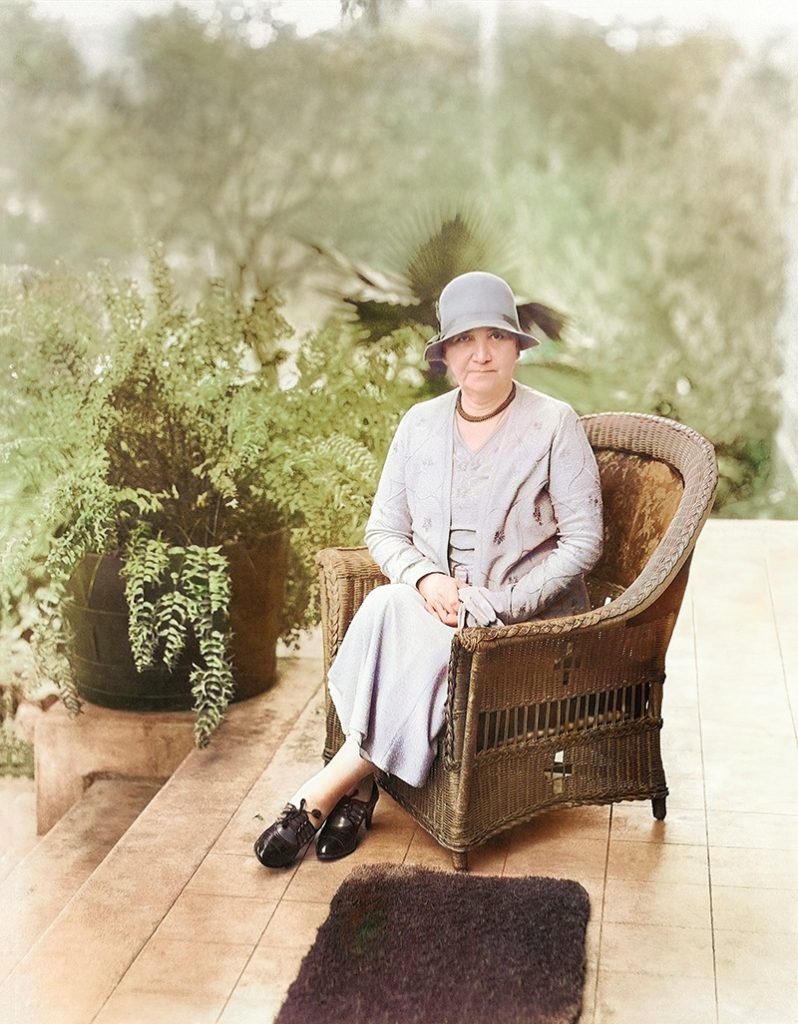
Rollins College President Hamilton Holt, whose storied tenure at the liberal arts institution lasted from 1925 to 1949, is justifiably remembered today as an innovative educator and an outspoken progressive who held, and at times expressed, views that flouted convention in Central Florida.
Holt’s prior editorship (and later ownership) of a highly influential national news and opinion magazine—as well as his undaunted activism for world peace—had made him a widely respected public intellectual well before his eventful and impactful stretch at the college.
So, given his stature, most locals allowed him some leeway. Even so, his progressive values were sorely tested and there were boundaries that he could not (or would not) cross. He would learn, perhaps to his surprise, that regardless of how precious it appeared, Winter Park was not New England.
Holt—whom his students called “Prexy” and his friends called “Hammy”—was a complex character and, like most everyone, displayed contradictions. Few incongruities, though, have been more puzzling over the decades than the unapologetic liberal’s friendship with—and admiration for—the particularly problematic Corra Mae Harris (née White).
Harris, a previously unpublished 30-year-old writer who hailed from Elbert County in rural Northeast Georgia, first attracted Holt’s attention when, in the late spring of 1899, she submitted an impassioned defense of lynching—yes, lynching—to The Independent, a New York-based magazine for which he was then the managing editor.
Holt—a native of Brooklyn whose maternal grandfather, Henry C. Bowen, had co-founded The Independent to advocate for abolition in 1848—was a 26-year-old graduate of Yale University with a degree in economics. He had spent three years working toward a doctorate in sociology and economics at Columbia College (now Columbia University) before deciding to launch his career “on the fitful sea of journalism” in 1897.
Shockingly, instead of tossing “A Southern Woman’s View” into the wastebasket and despairing that a seemingly intelligent person could espouse such appalling ideas, Holt declared himself impressed by Harris’s vivid style of writing (the sentiments that she actually expressed apparently notwithstanding) and excitedly shared the essay around the office.
In the ensuing years, he still recalled being “struck by its sincerity, simplicity and charm, the three graces of literary art,” and opined that “it evidenced in its form and substance that something we call genius.” He further described the staff’s reaction to the essay as comparable “to the day when Robert Frost—a young stripling of 18—sent in his first poem.”
The Independent published “A Southern Woman’s View” on May 18, 1899. And thus was launched the literary career of Corra (pronounced “Cara”) Harris—soon a regular contributor to the magazine whose byline appeared alongside those of the early 20th century’s most prominent figures in journalism, literature and politics.
Holt also quickly developed a warm personal bond with Harris, much to the bafflement of historians who have been unable to reconcile this fact with the lifelong crusader’s optimistic, egalitarian worldview. Yet, the unlikely pair’s mutual admiration, jarring as it now seems, was in fact genuine and manifested itself many times over the decades to come.
At Rollins, Holt would award Harris an honorary doctorate, invite her to speak at the Animated Magazine and appoint her to be the college’s “Professor of Evil.” (He had previously added a “Professor of Books” and had proposed adding a “Professor of Hunting and Fishing.” Such whims earned ridicule in academia but reinforced the college’s public image as—not unlike the man in charge—pioneering if at times idiosyncratic.)
Thirty-seven years later, Holt would deliver a eulogy for his unlikely protégé in which he declared that “Corra Harris knows the human heart as does, in my judgment, no contemporary writer in America—certainly no woman writer.” If that’s true, as far as racial issues are concerned, it’s no wonder that progress has been painfully slow.
A Southern Woman’s View
Was “A Southern Woman’s View” really that horrific? Could a man of Holt’s background and sensibilities—even considering the tenor of the times—possibly have believed that such a screed, however stylishly written, was a work of genius? Yes, apparently he could, which is even more disquieting in light of the brutal backstory.
In April of 1899, a Coweta County, Georgia man named Thomas Wilkes, alias Sam Hose, was accused of killing his employer, a farmer named Thomas Cranford, and raping Cranford’s wife. Wilkes was arrested and returned by train to the county seat in Newnan, where a mob was waiting at the station.
Wilkes was seized, mutilated and lynched before his body was set ablaze as a crowd of some 2,000 watched and cheered the spectacle. Some onlookers were rewarded with such souvenirs as the dead man’s internal organs and fragments of his bones. His knuckles were displayed in a local grocery store.
No one was ever arrested or tried for participating in this atrocity. But it was hardly an isolated incident. In fact, most historians agree that the “nadir” of race relations in the United States stretched from the end of Reconstruction through at least through World War I.
The Independent, naturally, expressed outrage at the widely reported savagery in editorials by T.G. Seward, an African American minister, and William Hayes Ward, the editor-in-chief and designated mentor to Holt—whose mother had become a part-owner of the magazine when Bowen died in 1896. (Holt would buy the magazine outright in 1912.)
Asked Ward: “Do those who defend the lynchings in Georgia know that lawless violence breeds violence? Is it any wonder that there is terror and hatred, all the result of interference with the beneficent action of the law?”
Harris—who was married to Lundy Howard Harris, a deeply troubled and ill-fated minister then teaching at the Piedmont Institute in Rockmart, Georgia—had prefaced her infamous response not as an excuse for the lynching but as an explanation for its “savage fury.”
Fair enough. A sincere effort by an insightful writer steeped in the region’s culture to analyze the sociological underpinnings of racial violence could have had value. But “A Southern Woman’s View” offered the sort of virulent white supremacist language that would have reinforced every negative trope held by the magazine’s readers about denizens of the erstwhile Confederacy.
“The negro,” wrote Harris, “is the mongrel of civilization … he has the savage nature and the murderous instincts of the wild beast, plus the cunning and lust of the fiend.” At no time, she contended, was a Southern white female, regardless of age, safe from “the insults and assaults of these creatures.”
When sheltered Northerners engage in “bitter denunciation of our avengers,” warned Harris, referring to lynch mobs compelled to defend Southern womanhood against brutes, “the negro takes it for granted that you are on his side. This cannot be true.” The incessant blather about social equality, she insisted, created conditions that encouraged the sort of violence for which lynching was the inevitable response.
Harris’s essay was published with a disclaimer stating that although The Independent’s editors didn’t endorse the “intrinsic value” of her opinions, they did believe—and not without ample evidence—that “A Southern Woman’s View” represented the views of most white women (and men) who lived below the Mason Dixon Line.
In the interest of balance—as if a debate about the propriety of lynching was warranted—the same issue included a reasoned analysis of race relations by African American sociologist and activist W.E.B. Du Bois, who called upon “the best elements of both races” to “sympathize with one another’s struggles.” Only then, wrote Du Bois, would lynching disappear.
That exchange should have marked the conclusion of a regrettable error in editorial judgment by The Independent. But Holt was thoroughly smitten—no other word seems adequate—by Harris’s work and wanted more. Soon to follow were essays entitled “Negro Womanhood” and “The Negro Child,” each of which built upon ugly themes of dehumanization and segregation.
It’s difficult to imagine that Ward—a respected scholar and clergyman and, nominally at least, Holt’s supervisor—shared his young understudy’s hearty approval of bigoted commentaries from the homespun Harris. But, as far as it’s known, he didn’t openly object to providing her with a platform through which her invective could reach a mass audience.
“Of course [“A Southern Woman’s View”] is horrible Southern apologia,” says Catherine Oglesby, professor emerita of history at Valdosta State University, whose 2007 book Corra Harris and the Divided Mind of the New South (University of Florida Press) explores Harris’s life, as well as the ideas and beliefs that influenced her writing. “It’s indefensible. It’s abhorrent. But, as we all know, this attitude was common for the time.”
In Holt’s case, she adds, his marriage to Alexina “Zenie” Crawford Smith may be instructive when struggling for explanations of his fondness for Harris. Born in Baltimore, Mrs. Holt was proud of her Southern ancestry that included such figures as Sir George Yeardley, who in 1618 became the first governor of the colony of Virginia.
Holt’s wife, notes Oglesby, was in many respects—including her attitude about race—perhaps not unlike Harris. Zenie, after all, disagreed with her husband’s criticism of Birth of a Nation, D.W. Griffith’s 1915 epic about the rise of the Ku Klux Klan during Reconstruction. He thought it incited racial hatred; she thought it was “a true picture of conditions.”
Most of Harris’s submissions to The Independent, thankfully, were not about race. “The Abomination of Cities,” “Men and Women: And the Woman Question,” “Marriage: New Profession or Old Miracle,” “The Woman of Yesterday,” “Politics and Prayer in the Valley,” “Was Eve a Feminist?” and others dealt with such topics as gender roles, social and political paradoxes, and the merit of premodern agrarian values.
Harris’s writing, at least when race wasn’t the topic, could be described as breezy with flashes of sarcasm and even wisdom. Yes—in print at least—she was a staunch traditionalist and a champion of old-fashioned domesticity, arguing that a woman’s highest calling was marriage and homemaking. However, she also became a highly successful professional who was widowed for 25 years and advised her own daughter to remain single.
In addition, despite her Southern apologist tendencies, Harris was a critic of the “Lost Cause” mythology that took hold following the Civil War. Proponents contended that slave owners were benevolent and enslaved people were content, while concurrently repositioning the conflict as a noble defense of state’s rights by the Confederacy.
Harris, though, believed that such magical thinking hindered progress and was mired “in the mind, manners and spirit of an antebellum past” that, in truth, never really existed—except in the nostalgic imaginations of overly sentimental writers who “squat about in military cemeteries to write their novels.”
She even satirized the subject in 1912’s The Recording Angel, a novel that Oglesby and other scholars believe is the only Harris work of lasting value and significance. “Plus, it was very brave,” says Oglesby. “At that time, it would have been career suicide for a Southern writer to publish these views. But it wasn’t for Harris.”
Further, although she promoted biblical Christian values, she wasn’t a biblical literalist, nor did she ever attend church once she was no longer obligated as a minister’s wife to be there. “Harris could be described as we sometimes describe people today—spiritual but not religious,” says Oglesby. “In general, she promoted tradition while also defying it.”
In her 1924 autobiography, My Book and Heart, Harris acknowledged her inconsistencies: “I do not know what God could have been thinking about when he made me—such a lie,” she wrote. “A being whose outside is an absolute contradiction to her inside. Whose every action is a concealment of truth, who can never be veracious except when she is writing fiction.”
That was true enough—except for her belief in white supremacy, which never seemed to waver. As Oglesby writes in her book, Harris maintained until the end of her life that the Black race as a whole was “of a lower order” and incapable of “ever attaining Caucasian standards of morals or civilization.’”
As Harris became more prominent, Holt continued to position The Independent as a champion of progressive thought. “Holt was interested in all reforms,” writes Warren F. Kuehl in his 1960 book Hamilton Holt: Journalist, Internationalist, Educator (University of Florida Press).
Adds Kuehl: “He was the social worker struggling to ameliorate slums, poverty, disease and other afflictions of the societal body. He was the crusader for social justice, shocked at economic and racial inequities, and active in support of any program which promised greater social or economic democracy.”
In 1906, Holt assembled a collection of 75 “lifelets”—a memorable moniker for brief but at times compelling autobiographical sketches of “the humbler classes”—into a book called The Life Stories of Undistinguished Americans: As Told by Themselves.
One chapter, “The Life Story of a Negro Peon,” featured a Black man in Harris’s home state who had been victimized by the practice of leasing convicts to private individuals and companies, thereby creating a new system that retained the exploitation and brutality of slavery. Many “peons” had been arrested on dubious charges to increase the pool of free labor. (The state abolished the practice several years later.)
In 1908, Holt caused something of a scandal when he addressed a meeting of New York’s Cosmopolitan Club where, according to a salacious account from the Baltimore Sun, “white men and women sat elbow to elbow with colored men and women while they discussed social equality and cheered at the suggestion of intermarriage as a solution to the race problem.”
Although The New York Times carried a sober and straightforward account of the event, newspapers across the country picked up the more sensational story from the Sun. Faced with blowback, Holt complained bitterly that his position had been misrepresented. And then he made things worse by demanding retractions.
Yes, he told the press, he had mentioned intermarriage but had not endorsed the practice: “I said that intermarriage, if it were to be between white men and colored women and not between colored men and white women, would bleach the race, but I rejected this as a proper solution. I then laid stress on the education of the negro as the best means of dealing with the problem.”
Holt had rather clumsily referenced the theory of “absorbing” people of color into the white population—antithetical to the prevailing “one drop” mentality toward race—while also attempting to assuage concerns about the preservation of white womanhood. It didn’t work.
In response, many Southern newspapers launched a fresh round of editorials arguing that whether or not there had been an implicit espousal of intermarriage was entirely beside the point. It was a distinction without a difference—dangerous either way. Simply acknowledging “miscegenation” as an option, even one that’s fraught, was egregious enough.
Wrote the News & Advance in Lynchburg, Virginia: “The man who sees no harm in the fact of Negroes and whites dining together, approves the principle of social equality between the races, and says he does not approve of race amalgamation can do so only at the price of logical stultification.”
Among those most critical of Holt was Harris, to whom Holt had apparently mailed the relatively innocuous clipping from The New York Times. But why? To explain himself? To solicit a dispassionate opinion? To commiserate about his ill treatment? If so, he ought to have known better.
In a blunt return missive, Harris first credited Holt with having “the noblest of motives” before asking how he could tolerate “the revolting sight” of white women and Black men seated together at a social event. She then went further—using the n-word and castigating all the white women who attended as likely “morbid and revolting.”
Given Harris’s opinion about the Cosmopolitan Club debacle, she must have been beside herself in 1909, when Holt became a founding member of the National Association for the Advancement of Colored People—the impetus for which was an editorial in The Independent by labor reformer William English Walling following the previous summer’s bloody Springfield (Illinois) Race Riot.
Holt also attended annual conferences convened by educator Booker T. Washington, founder and first president of the Tuskegee Institute (now Tuskegee University) in Alabama. While visiting the school—much to Zenie’s dismay—he usually stayed as a guest in Washington’s home.
In 1919, Holt revisited the topic of lynching, penning an editorial for The Independent called “America’s Shame,” in which he condemned the continuing practice as a “monstrous system of injustice” and a “disgrace to our civilization.” He argued that the nation’s inability (or unwillingness) to protect its Black citizens, particularly veterans returning from World War I, was a deep moral failure that contradicted democratic ideals.
Assuming that the prolific Harris—who contributed several essays to the magazine that year—read the commentary, she must have shaken her head in disbelief at her friend’s continuing naivete. She had not softened her view that lynching, while distasteful, was inevitable as long as Northern idealists preached equality and exerted “a regrettable influence on the negro race.”
Sometimes, though, even all-encompassing crusaders must pick their battles. In Holt’s case, he had already become thoroughly immersed in promoting peace through an alliance of world governments that would have the legal authority to mediate disputes between nations or, if necessary, to quash intransigent oppressors.
He barnstormed the country, delivering lectures under the auspices of such organizations as the Peace Society of New York, the World Peace Foundation and the Carnegie Endowment for International Peace. He consulted with presidents and used the bully pulpit of his magazine to advocate for a “federation of the world.”
Holt’s peripatetic activism didn’t result in world peace, however, and might have hastened the demise of The Independent, which was already facing stiff headwinds. Such contemplative (if wordy) weeklies had begun to disappear in the early 1920s as a result of rising costs, declining revenue and public demand for lighter fare such as that offered by The Saturday Evening Post and The Ladies’ Home Journal.
The Independent—which had fought the good fight for 73 years—was absorbed in 1921 by a newer competitor, The Weekly Review. Holt, after disassociating himself from the successor publication (which declared that its purpose was to “promote the principles of liberal conservatism”) needed a steady source of income—and hopefully one that required less travel.
Such an opportunity came in the summer of 1925, when Irving Bacheller—a bestselling author and a member of the board of trustees at Rollins—wrote Holt to gauge his interest in the presidency of the college. Noted Bacheller: “It’s a cinch for a man of your capacity.” The salary would be $5,000 per year.
Holt, who relished the challenge of reforming the stodginess he had perceived in higher education, said yes, thereby changing the trajectory of the college’s history. Yet, while his accomplishments during his 19-year tenure would be legendary, vexing issues surrounding race—and, by extension, the college’s association with Corra Mae Harris—would also become part of Holt’s legacy.
A Circuit Rider’s Wife
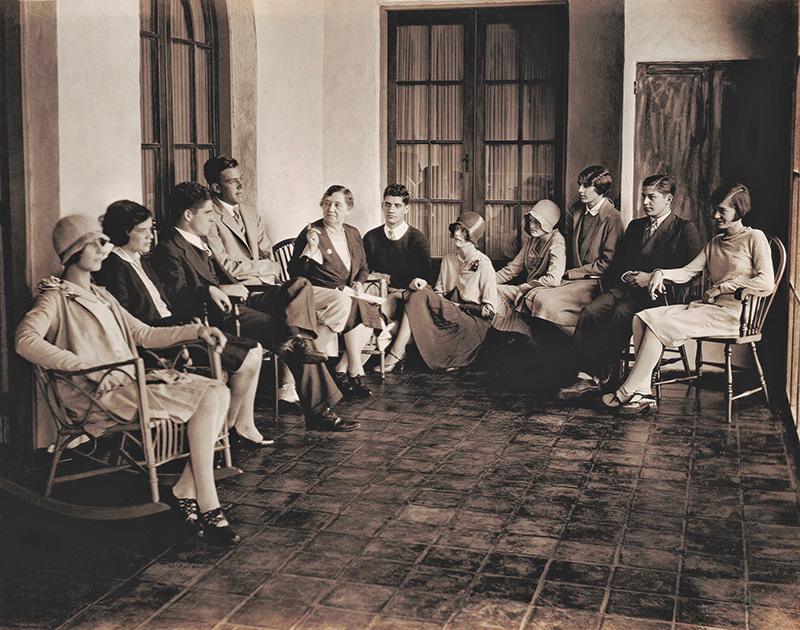
In February of 1927, Holt—a lover of academic pageantry—invited Harris to visit his home in Winter Park to participate in Founders’ Week, which he had decreed would be celebrated on campus annually during the third week of each February. (Those activities would include, belatedly, his formal inauguration.)
She would also speak at the inaugural Animated Magazine—an event that featured prominent authors, academicians, religious leaders and cultural figures—and in ceremonies the following day would receive an honorary degree: a Doctorate of Humane Letters.
By then, Harris was herself a national figure—albeit one whose work had fallen out of vogue. In her heyday, however, she had published 19 books, two of which—My Book and Heart, from 1923, and As a Woman Thinks, from 1925—were well-received autobiographies. She had also notched hundreds of essays, book reviews and short stories in such major magazines as Harper’s and the Ladies’ Home Journal.
And Harris was sent twice to Europe by The Saturday Evening Post, once to report on women’s suffrage efforts and later—this time as one of the country’s first female war correspondents—to chronicle “the women’s side” of World War I. Her articles such as “The New Militants” and “The Bravest of the Brave” argued that women were active participants in the war effort—not just passive victims.
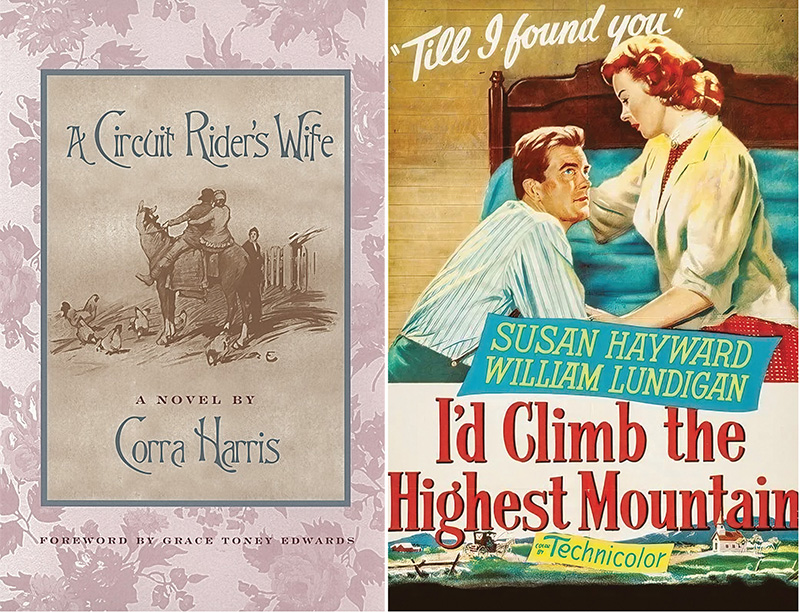
Most significantly, however, in 1910, Harris penned a bestselling novel, A Circuit Rider’s Wife, which was a work of sentimental fiction inspired by the first year of her marriage to Lundy Howard Harris, who was then an itinerant minister in the Methodist Episcopal Church, South’s Redwine Circuit that spanned rural Hart County, Georgia.
(In 1951—more than 15 years after the death of Harris—the book would be adapted as a popular film, I’d Climb the Highest Mountain, which starred Susan Hayward and William Lundigan as “William and Mary Thompson,” the idealized counterparts of Lundy and Corra. A lesser-known film based on her writings, Husbands and Wives, had been released in 1920 and is now owned by Turner Classic Movies.)
In fact, an unvarnished account of the Harrises’ actual life together would have made a considerably darker story. In 1898, Lundy, who was tormented by spiritual doubt and suffered from alcoholism, anxiety and depression, abandoned his family—which encompassed his wife and a 1-year-old daughter, Faith (two other children had died in infancy)—and absconded to Texas.
He returned the following year and publicly confessed to an array of sins, including having intimate relations with women of color. Biographer Oglesby contends that Harris, although devastated, ultimately became more determined to pursue literary success so that she could become self-reliant and support herself and her daughter if necessary.
Born on a heavily mortgaged cotton plantation to a hard-drinking Confederate veteran and his deeply religious wife, Harris—whose only formal education amounted to intermittent stints at a female academy in Elberton, Georgia—had experienced genteel poverty as a child and indicated no desire to become plain old “disrespectfully” poor, as she believed many in soft-hearted Lundy’s flock had been.
In the fall of 1899, after temporarily regaining his equilibrium, Lundy accepted a position teaching at Young Harris College in north Georgia, near the border with Tennessee, and served as a “supply preacher” at churches located in Augusta, College Park and Groveton. Two years later, he became assistant secretary of the Methodist Episcopal Church, South’s Board of Education at Vanderbilt University in Nashville.
Harris, whose published work already included “A Southern Woman’s View” in The Independent, continued to write for that publication and others, including Uncle Remus, The American Magazine, The Critic and The Saturday Evening Post. Her talent was unpolished—her spelling and grammar were notoriously slapdash, and her relationship with facts was tenuous at best—but that’s when good editors work their magic.
And Holt was a very good editor indeed. “He cannot if his life depended on it say what the other fellow has to say,” said Harris years later in an interview with the Washington Herald. “But he can make the other fellow say it because he knows it is there. Holt has often caused me to write wisely on subjects of which I had supposed myself to be ignorant.”
Another skilled wordsmith was Paul Elmer More, literary editor of The Independent, who had blue-penciled Harris’s early book reviews. In 1903, they collaborated on The Jessica Letters: An Editor’s Romance, which was inspired by their own correspondence. The novel consists only of letters between “Jessica Doane,” a spirited and chatty young writer from Georgia, and her editor, “Philip Towers,” a reserved and sophisticated intellectual from New York.
Readers seemed to agree that Harris’s Jessica was far more likable than More’s Philip, whose flesh-and-blood doppelgänger—an influential scholar, philosopher and literary critic—was described in his biography as “critical, self-centered, unsociable and aloof.” Oglesby says that although Harris revered More, she’s quite convinced that the romantic plotline of The Jessica Letters remained purely hypothetical.
In January and February of 1910, The Saturday Evening Post serialized A Circuit Rider’s Wife, which was published as a novel later that same year and was lauded for its “witty but caring” assessment of the differences between “spiritual and merely religious folks” as well as its unsparing depiction of church politics and the financial and emotional hardships faced by rural clergymen and their families.
Harris told Lundy—who had been unemployed following another emotional collapse and an attempted suicide in 1908—that their financial troubles were over. They would, she assured him, “get away presently from all the care we have ever had, take a little house in the country and begin to live happily ever after.”
It wasn’t to be. Just months following the release of A Circuit Rider’s Wife—in September of 1910—Lundy died by suicide after drinking morphine in a cotton field near the community of Pine Log in Bartow County, Georgia. He left behind a note that read: “I am so tired and want to go where rest is never broken.”
A full-page feature in The New York Times—a reflection of Harris’s newfound fame—reported that those who knew Lundy noticed that he “fell into profound melancholy” after publication of the book, which he “seemed to think [was] a story of a vision unrealized, and that his life had been a failure.”
Others later disputed the assertion that Lundy’s suicide was in any way prompted by his wife’s book. Harris never addressed this theory—she had, in fact, been nothing but supportive of her erratic husband—and Oglesby points out that Lundy had deeper problems. “He couldn’t withstand the onslaught of scientific discoveries that had caused him to question his faith,” she says. “To him, this became a psychic crisis.”
In 1913, Harris—seeking the sort of permanent home that had eluded her during her nomadic (and traumatic) marriage—bought a rustic cabin and approximately 200 acres that encompassed the ground on which Lundy took his own life. She named the bucolic expanse “In the Valley” and expanded the cabin to 17 rooms including a library.
There, where she said she could feel Lundy’s spirit surrounding her, Harris enjoyed the most productive years of her career. But, at the time of her first visit to Winter Park, she had developed heart disease and was in frail health. Her daughter, Faith Harris Leech—a budding writer—had died in 1919, while her sister, Hope White, had died two years later.
Although two sequels to A Circuit Rider’s Wife—in 1916 and 1921—had been well received, by the late 1920s readers had begun to turn a deaf ear to conservative moralizing. As a result, the same major magazines that had once embraced Harris’s work no longer sought submissions from her.
Holt, though—who was so proud of having discovered Harris—must have been pleased to now pluck her from impending obscurity. Little did he realize, however, that people would still be talking about his opinionated friend nearly 100 years later—but for reasons that he clearly did not anticipate.
At the Animated Magazine, Harris presented a glowing review of Irving Bacheller’s 1920 novel, Dawn: A Lost Romance of the Time of Christ, which imagines the life of the woman to whom Jesus said: “Go and sin no more.” The work, which tells a fictional tale of redemption against a backdrop of biblical events, was certainly well suited for a commentary by Harris.
When Harris was awarded her honorary degree, Holt, as was his wont, spoke with eloquent reverence. Today, given current sensibilities, parts of his over-the-top tribute seem as tone-deaf as his earlier accolades for “A Southern Woman’s View.” But, as always, he ignored her racism—a character flaw that, in his opinion, was unfortunate but not unforgivable—and spoke his version of the truth.
Intoned Holt: “Corra Harris, circuit rider’s wife, Faith’s mother, noble-minded author of noble-minded books, for your insight into the human heart, for the courage, consolation and hope you have brought through the printed word to thousands of unknown friends, for the good fight you have fought, the faith you have kept, Rollins College confers upon you the degree of Doctor of Humane Letters and admits you to all its rights and privileges.”
The Nature Of Evil
Harris, despite her worsening health, returned to Rollins at Holt’s behest during the winter semester of 1929–30 to again speak at the Animated Magazine—her topic this time was “Man, the Most Evil of all Lower Animals”—and to teach a course on the nature of evil. Holt even gave Harris a title—”Professor of Evil”—and saw to it that newspapers around the world received press releases.
Most covered the story in bemused fashion, while others ridiculed what they rightly viewed as a publicity stunt. Spencer Murphy, the widely respected executive editor of the Salsbury Evening Post in North Carolina offered a particularly pointed observation: “Corra Harris has become Professor of Evil at Rollins College, thereby illustrating that she has a gift for originality which nobody would have expected from reading her novels.”
Others questioned what qualified Harris—who was considered by many in literary circles to be a writer of lowbrow domestic fiction who lacked intellectual gravitas—to teach a college-level subject on a weighty moral issue with which history’s greatest philosophers had grappled since time immemorial.
No one, it appears, flagged her racial views—arguably evil in and of themselves—as disqualifying. And it wasn’t as though she had mellowed. In My Book and Heart, published five years earlier, she had reaffirmed the righteousness of “A Southern Woman’s View” and credited the controversy it sparked as proof “that I must have hit the nail right on the head.”
But memories fade, and in those pre-internet days, imprudent or offensive published comments weren’t as easy to amplify or to uncover. Probably, in the wake of Harris’s mainstream success, no one remembered an incendiary essay from a defunct magazine published nearly three decades earlier. And even if they had, it likely wouldn’t have mattered.
The Atlanta Constitution, perhaps not surprisingly, considered the whole idea of a course on evil to be splendid. “Mrs. Harris has spent most of her life breathing the atmosphere of clean thinking and moral living,” enthused the hometown newspaper of the most famous woman writer from the Peach State. “She has studied human personal equations with accurate discernment of motivation and accurate analyses of moral and immoral results.”
The course would not, explained Holt, “consider the actual practice of evil but rather the history and philosophy of it, as contrasted to virtue.” Harris added that concepts of good and evil were usually taught by people who were “morally illiterate and mentally corrupt,” adding that her approach would be to “prepare [students] to deal intelligently rather than emotionally with instincts—not merely of the body but of the mind.”
However, despite the hoopla surrounding it, the course was a bust. It appears to have met three times—illness forced Harris to return early to Georgia—and even Holt, ever the publicist, confided to colleagues that he had subsequently thought better of the entire notion.
In February of 1934, just a year prior to her death, Harris returned to Rollins for a final time to give a talk, this one entitled “Their Faces and Their Books,” at the Animated Magazine. By then, most of her published writing appeared in the Atlanta Journal, where she penned a folksy three-times-weekly feature called “A Candlelit Column.”
Corra Mae Harris—who, for better or worse, remained resolutely herself—died of a heart attack on February 9, 1935, and was interred on her property, near her cabin. A chapel designed by Ralph Adams Cram—who had also designed Knowles Memorial Chapel at Rollins—was built two years later to encompass her final resting place.
Holt, at a dedication service for the small marble structure, said of Harris that he had “never met a soul in my life who could tell you so many true things about yourself you never even suspected before, and yet you instantly recognized as so. To be sure, she was occasionally wrong, [but] her bullseyes far outnumbered her misses.”
No doubt, Holt considered “The Town that Became a University” to be among her bullseyes. The essay, originally written by Harris for the Jacksonville Times-Union in 1929, praised the accomplishments of her former editor: “Another boom, educational this time and as yet no larger than a man’s hand, has started in Florida, where the trustees went crazy four years ago and elected Hamilton Holt president of the college.”
Harris then recounted Holt’s “provocative” undergraduate academic reforms—including his vaunted “conference plan,” which emphasized one-on-one interaction between professor and student—and described picture-postcard Winter Park as having become, as a result of Holt’s vision, “a university at large.”
The college published the essay—along with an equally laudatory commentary by Harris headlined “Pioneering in Education”—as a promotional pamphlet in 1937 and disseminated it for decades thereafter. In his introduction, Holt wrote: “Corra Harris captured the very essence of Winter Park in her two delightful essays here republished.”
Then he added: “But the reader must not take too seriously her references to me. I was the one who ‘discovered’ her literary genius 38 years ago when I was office editor of The Independent and she was the young ‘Circuit Rider’s Wife’ living in the midst of the carmine hills of Georgia. Until the day of her death two years ago we have been bound together in the ties of friendship, and friendship magnifies the friend.”
Crusader Turns Cautious
At Rollins, Holt would confront several major racial issues following the death of Harris. “Holt may have thought, with some justification, that Winter Park and Central Florida were not really ‘Southern,’ that decades-long northeastern colonization of the area had created a condition more amenable to racial harmony,” writes Jack Lane, the college’s historian and professor of history emeritus. “He would be badly mistaken.”
In a 2022 essay entitled “Rollins College and Race in the Era of Segregation: 1885-1954,” Lane notes that Holt “brought with him to Rollins a national reputation as an advocate for African American rights with a strong dislike of the segregation system—attributes completely at odds with white supremacy views held by most Central Floridians.”
Holt surely knew that in 1920, just five years before his arrival, there had been a lynching in downtown Orlando related to what came to be known as the “Race Massacre” in nearby Ocoee. He may not have realized, however, the extent to which the KKK was active throughout the region or that Jim Crow practices were deeply entrenched even in harmonious Winter Park.
Faced with this reality, over time he became a gradualist on race and made several decisions that galled him personally but that he believed would protect the college (donors could be particularly reactionary) and preserve amity in the broader community.
In October of 1932, when Eatonville-raised author and anthropologist Zora Neal Hurston—with the support of several faculty members—sought to present a folklore play with a Black cast on campus, Holt agreed, but only reluctantly and with conditions.
Among them: that the play be staged in the Recreation Hall, not the more high-profile Annie Russell Theatre, and that the audience be either all white or separated by race through seating arrangements. Added Holt: “I do not think it would be wise to advertise it very much outside our own faculty and students but I may be wrong about this.”
In March of 1947, Holt may or may not have attended a statewide gathering that was called, without hyperbole, “A Conference to Defend Democracy in Florida.” The event was hosted by his church, First Congregational Church of Winter Park—the very institution that had chartered the college in 1885.
Convened by the New Orleans-based Southern Conference for Human Welfare in cooperation with the Florida State Conference of NAACP branches and the Progressive Voters League of Florida, the meeting featured presentations by clergy members, civil rights activists, labor leaders and a sociology professor, Edwin L. Clarke, who served on the Race Relations Committee at Rollins.
Also on the roster was Mary McLeod Bethune, founder of what would become Bethune-Cookman University in Daytona Beach, and Harry T. Moore, executive secretary of the Florida NAACP. Bethune, if not the more controversial and confrontational Moore, enjoyed a genuine friendship with Holt. Yet it’s unclear if he attended personally or judiciously steered clear to avoid potential backlash.
The purpose of the gathering was to organize opposition to a bill in the Florida House of Representatives that would have redefined the Democratic Party as a private organization, thereby allowing party officials to legally prohibit voting by Blacks. (The bill ultimately passed the House but failed in the Florida Senate.)
For hosting the conference, Rev. Louis Schulz, senior pastor at First Congregational, had a cross burned in the front yard of the church’s parsonage. Moore and his wife, Harriette, were killed in 1951 when dynamite was detonated beneath their home in Mims. (The Moores, consequently, are now considered to be the first martyrs of the civil rights movement.)
In November of 1947, when Ohio Wesleyan insisted on bringing an African American football player, Kenneth Woodward, to the homecoming football game against Rollins at the Orlando Stadium (now Camping World Stadium), Holt canceled the game under pressure from the college’s trustees when the Battling Bishops refused to leave Woodward behind in Ohio.
Holt, who privately fumed that “the decision taken was not right,” must have been humiliated by such national headlines as “Game Canceled Because of Negro.” Four days later, though, he dutifully gathered Rollins students and faculty in the Annie Russell Theatre and attempted to justify the trustees’ stance.
He said (but may not have entirely believed): “You will probably have critical decisions like this to make as you go through life; decisions that whatever you do, you will be misinterpreted, misunderstood and reviled.” Playing the game, he added, might have “precipitated a crisis” that would have been detrimental to the cause. It was better, he concluded, “to work quietly for better race relations, hoping and believing that time would be on our side.”
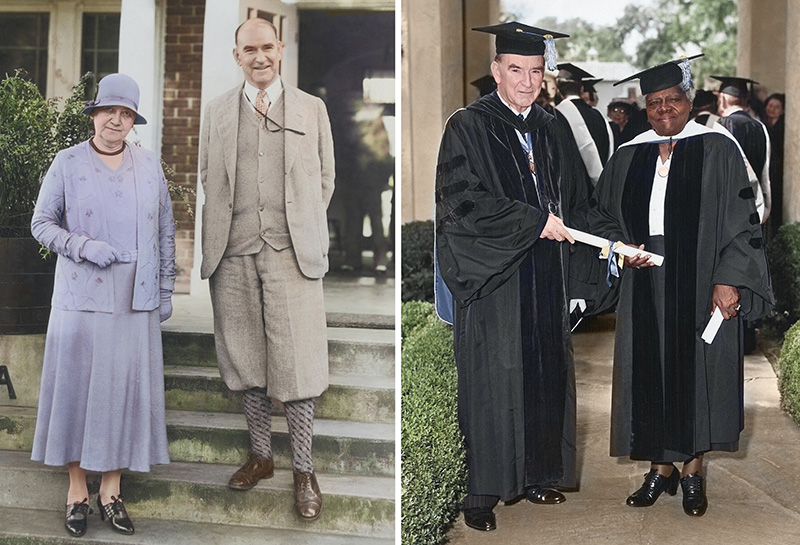
In early 1948, the fed-up Holt (perhaps, in part at least, to assuage his conscience) proposed awarding a Doctorate of Humane Letters—the same degree that he had given Harris two decades earlier—to Bethune, the educator who in 1931 had spoken eloquently about race relations before a “spellbound” audience of students at what was then the college’s chapel. When the trustees balked, however, Holt threatened to resign.
It was Bethune who talked him out of it. “I believe far more good will be accomplished by your remaining president of the college than anything I could possibly say in 15 or 20 minutes of speechmaking,” she told the chagrined Holt. “With you at the helm, there will come a day when attitudes will be different.”
So in June of that year, Holt instead awarded a Decoration of Honor to Susan Wesley, a beloved African American housemaid at Cloverleaf Hall—a girls’ dormitory—since 1924. Clearly, and with all due deference to the deserving Wesley’s loyal service, it was her non-threatening position at the college that made such an honor possible. The recognition was a kind, but hardly heroic, gesture.
Then, in February of 1949—a year prior to his retirement—the aging crusader reasserted himself and finally awarded the honorary degree to Bethune. It was important to Holt, not only because the recognition was deserved but also because granting it would bolster his own legacy as a racial progressive after years of acquiescing to Jim Crow. This time, the trustees went along.
“I am proud that Rollins is, I am told, the first white college in the South to bestow an honorary degree upon one of your race,” said Holt at ceremonies honoring Bethune. He noted that her example proved that it was possible “to rise from the humblest cabin in the land to a place of honor and influence among the world’s eminent.”
Holt’s last stand, belated though it was, was a redeeming factor in the view of some sympathetic historians. In a 2021 essay entitled “Pathway to Diversity–The History of Race Relations at Rollins: A Brief Overview from the Archives, Part One: 1885–1951,” Wenxian Zhang, a professor and head of archives and special collections at the college’s Olin Library, concludes:
“In the end, despite his own limitations and surrender to political pressures in the segregated South, Holt ultimately was able to stand on the right side of history and make his mark on social integration in the United States.” He did not, however, make such a mark at the college that he led, where the first Black student would not be admitted until 1964.
Holt—whose leg had been amputated the previous September due to complications from diabetes—died on April 26, 1951, at his home in Woodstock, Connecticut, a picturesque village in the northeastern corner of the state. Surely the twin responsibilities he had taken upon himself—saving education and saving humanity—had weighed on his health and on his psyche.
Nathan C. Starr, a popular professor of English at the college, spoke for the campus community when he said: “All of Holt’s achievements are less than the man himself. Those of us who were close to him were truly uplifted by his greatness of spirit and our hearts were warmed by his humanity.”
Biographer Kuehl believes that, in general, Holt “was both a success and a failure” whose failures were the result of “supreme idealist goals…which were beyond attainment.” His ideals, writes Kuehl, “remain a challenge to journalists, statesmen, educators—to all who seek a better world.”
“Prexy’s” racial legacy, while decidedly mixed, should be judged in context. He was, without question, an effective advocate while ensconced in New York. His moderation after moving to Florida, although vexing when contrasted with his rhetoric, was at least pragmatic considering the possible financial consequences to the college of taking too many stands that were contrary to entrenched local attitudes.
Still, in the fullness of time, these episodes haven’t aged well. That’s particularly true of his relationship with Harris, which historian Lane has examined in “The Complicity of Silence–Race and the Hamilton Holt/Corra Harris Friendship: 1899–1935.” His insightful, no-holds-barred essay was published—rather ironically—in a short-lived, on-campus revival of The Independent.
Lane compares Holt’s unwillingness to denounce Harris to the passivity of otherwise respectable citizens who professed horror at lynchings but took no concrete action to stop them—instead either justifying them, as Harris did, or accepting them as an unpleasant fact of life, as perhaps a majority of others did. Such resignation, argues Lane, amounts to complicity.
“Since he never criticized the racist views Harris expressed in her early articles and in those letters written to him, Holt left the impression that style mitigated objectionable content,” writes Lane. “However, malicious, hurtful views argued by ‘geniuses’ with sincere and charming writing styles are far more dangerous than those who use simplistic, coarse language.”
Lane, of course, is correct. Further, just imagine the furor that would result if a modern-day Rollins president were to befriend and welcome to campus, for example, Harry Potter author J.K. Rowling—whose aggressive transphobic trolling has, to many, deeply tarnished her stature as a beloved literary figure. Or, even more incendiary, white nationalist media figure Nick Fuentes.
Either would be a provocative presence now at most colleges. But nearly a century ago, Holt—with his expansive, inclusive, empathetic personality—believed that there was more to Harris than her unrepentant racism (which was, after all, relatively mainstream at the time) and chose to embrace her, warts and all.
Harris, too, all but worshiped Holt, despite the fact that his core beliefs seemed as wrongheaded to her as her core beliefs seemed wrongheaded to him. Taking all this into account—and without drawing a false equivalence between Harris’s bigotry and Holt’s big-heartedness—their flawed friendship is perhaps easier to understand if not to condone.
Controversial Cancellation
When Harris died, she left her estate to three nephews and set up a trust to maintain her home and grounds, In the Valley. Either or both of the Raines sisters, Betty and Trannie—who had lived with Harris and worked as household assistants—could remain in the home rent-free for as long as they remained unmarried, according to the will.
Eventually, however, both sisters married and the property was offered to the United Daughters of the Confederacy and the Daughters of the American Revolution. However, both organizations declined, and by 1949, the trust was exhausted. Trannie and her husband then bought the cabin and the acreage from Harris’s two remaining nephews.
Subsequent owners began selling the property piecemeal. Then, in September of 1996, Marietta insurance executive Jodie Hill—a preservationist who was concerned that the remaining 56 acres of rolling hills and pine trees would be cleared and developed—bought it at auction and began to restore the cabin to how it would have looked during Harris’s lifetime.
In early 2000, Hill and Marilee Henson, a civic leader in Bartow County, began the Corra Harris Garden Club, which managed the property and hosted lectures and holiday open houses. The club’s mission was inspired by the words of Harris, who once contrasted “the soulless moiling” of urban life with the joy she found “in a happy garden” where “my spade chortles, the poppies flaunt their red skirts of abandon.”
In December of 2008, Hill—nearing age 90—donated the property to Kennesaw State University, which planned to use it for teaching archeology, history, literature and environmental studies. Although some who were aware of Harris’s racial views vehemently objected, the sale was consummated.
All seemed well until 2013, when multimedia sculptor Ruth Stanford, an associate professor of sculpture at Georgia State University, was invited by Kennesaw State’s new Bernard A. Zukerman Museum of Art to create an installation based on In the Valley. The museum, as events unfolded, discovered that it had kicked a proverbial hornet’s nest.
Stanford had never before heard of Harris. But what she found out during her year of preparation, while shocking and at times confusing, presented her with an irresistible challenge: to present Harris fairly to a modern-day audience and to explore “how we respond to a place over time.”
The installation, A Walk in the Valley, opened in March of 2014 and included glass cases that exhibited Harris’s books with shredded pages spilling out alongside ancient artifacts uncovered on the property by archaeologists. There were also slices of a tree, the inside polished and smooth and the outside knotted and gnarly.
On the walls were sepia photographs of Harris in various settings around the homeplace with her ghostly figure blotted out in white. As for “A Southern Woman’s View,” it was there, too, overlaying a 10-by-10-foot map of north Bartow County with the most inflammatory language blacked out as a testament to its ugliness.
Three days prior to the opening, Kennesaw State President Daniel Papp previewed the exhibition and demanded that it be taken down because, as he told the Atlanta Journal-Constitution, it “did not align with the celebratory atmosphere” of the museum’s opening.
Members of the local arts community, however, were outraged a museum exhibition—however controversial—had been suppressed. Petitions were circulated, boycotts were proposed and the decision was condemned by the National Coalition Against Censorship. A week later, the school relented and agreed that the installation could be displayed with “related programming” to add context.
By February of 2020, Kennesaw State had decided to divest itself of In the Valley. The Bartow County Commission entered into a lease-purchase agreement with the Etowah Valley Historical Society, which now owns the property. It’s open for tours by appointment only and the cabin is used as a venue for small meetings and conferences. The college continues to house artifacts recovered there and to cooperate on educational programs.
What would Harris have made of all this? She had expressed hope that her work would be read after she had spent “a very long time in heaven.” But she also seemed to recognize that time was not always forgiving. “Justice is a queer thing,” she had written in a 1915 novel. “We do not understand it yet. We do not live long enough to balance the scales over in the second and third generation.”
Still Etched In Stone
The Walk of Fame, created by Holt in 1929, began with selection of 22 stones from the homes of prominent people that he had accumulated in Woodstock. Today, 597 stones can be seen along the route, which runs in a semicircle around the Mills Lawn at the heart of the campus.
The stones are eclectic, inscribed with names that range from Aristotle to Oscar Wilde, alongside just about everyone else to whom Holt awarded an honorary degree. A casual stroll will reveal names that nearly everyone knows as well as others that will prompt searches on Google.
In August of 2020, nine stones that honored Confederate generals were quietly removed, although the college acknowledged that the stones of some “problematic” figures may still remain.
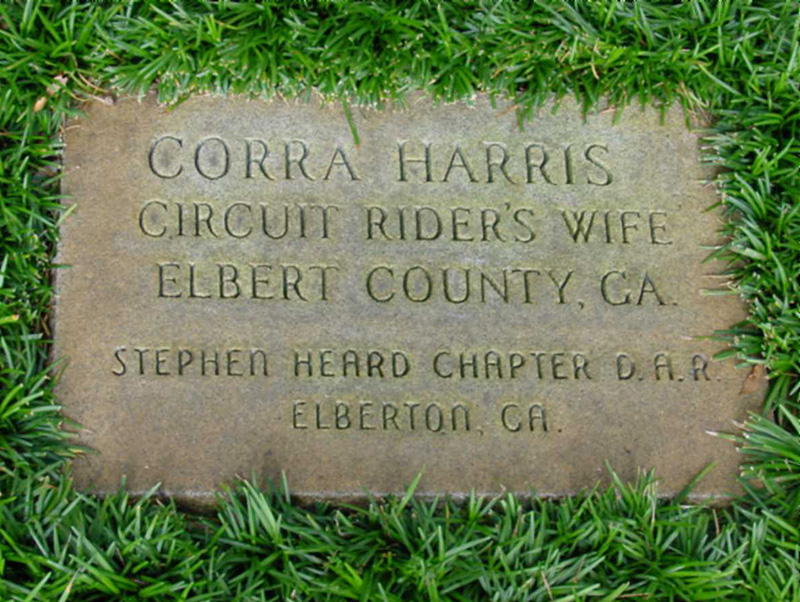
Surely one such problematic figure—a figure who might well agree with that description—would be the enigmatic woman whose legacy still stirs strong emotions more than 90 years after her death. The stone reads:
CORRA HARRIS
CIRCUIT RIDER’S WIFE
STEPHEN HURD CHAPTER D.A.R
ELBERTON, GA.