
The idea of a new performing arts center in the heart of downtown Orlando dates back at least 40 years—but, for a variety of reasons, the project languished for all those decades.
Now, though, as Dr. Phillips Center for the Performing Arts celebrates its 10th anniversary season, the leader most responsible for bringing the idea to life has been honored with a prominent (and permanent) presence in the multivenue building’s sleek and sophisticated Della Phillips Lobby.
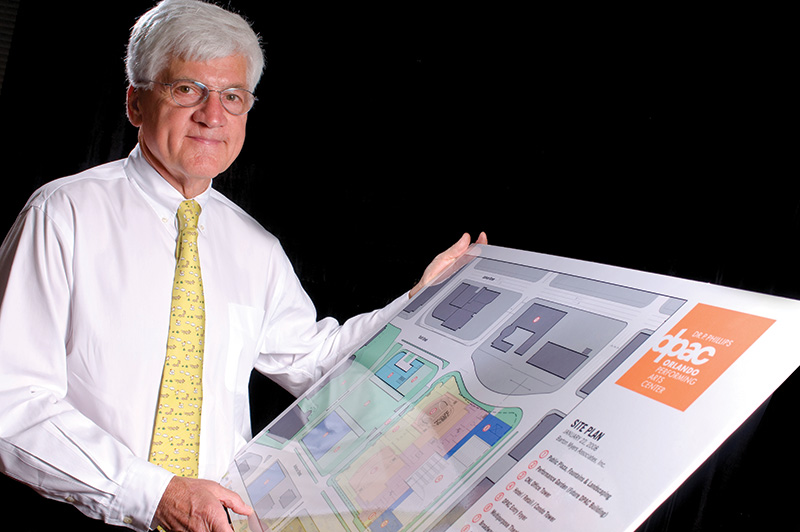
Winter Park resident James H. “Jim” Pugh Jr.—who with his wife, Alexis, was the project’s first donor—also served as chair of the arts center’s board of directors for nearly 20 years before becoming chair emeritus in 2022.
Pugh’s tenure as chair, which saw the arts center through conception and completion despite seemingly insurmountable hurdles along the way, has been memorialized in a sweeping bronze relief sculpture created by Dijon, France-based sculptor Paul Day.
Day’s meticulously detailed photorealistic approach—combined with his dynamic, sometimes surreal settings and skewed perspective—gives his creations a powerful narrative quality. So the sculpture, which measures 9-by-6 feet and weighs 900 pounds, not only salutes the honoree but tells the arts center’s story and spotlights its mission of “Arts for Every Life.”
Most prominently shown among the 30-plus characters who occupy the alto-relievo image is Pugh himself, wearing a conservative business suit and standing slightly off center in the foreground. He is flanked by construction workers on his left, while on his right are actors, dancers, singers and orchestral musicians being led by a baton-wielding conductor.
In the background are anonymous audience members seated in tiered balconies. The composition is dense, typical for a sculpture by Day, with light and shadow adding drama and depth. Pugh, who appears calm and assured, is surrounded by frenetic movement and creative energy.
“I envisioned a connection between Jim, a kind of grand conductor of the project, and the orchestra conductor,” said Day in an interview with Winter Park Magazine. “The musicians and the construction workers are reflections of one another. But I hope when people see the work, they’re intrigued enough to make their own interpretations.”
You may be familiar with Day’s work through the now-iconic statue of Fred Rogers (TV’s Mister Rogers), A Wonderful Day for a Neighbor, which was unveiled on the campus of Rollins College in 2021. Rogers, who in the statue is surrounded by children, was a music theory major who graduated from the college in 1951.
For the sculpture honoring Pugh, a standing-
room-only crowd that was studded with dignitaries attended an unveiling ceremony in October. Among them was Orlando Mayor Buddy Dyer, who had made completion of the arts center a cornerstone of his first campaign in 2003.
Dyer recalled how Pugh was put in charge of the massive (and elusive) project. The night before the election, he telephoned the mayor-to-be and said: “Hey, I’d like to help you with that performing arts center.” Dyer’s fateful response: “Hey, then you can lead it.”
So Pugh did exactly that, navigating the project through travails and triumphs, and eventually presiding over the opening of its major performance spaces: Walt Disney Theater, Steinmetz Hall and, of course, the Alexis & Jim Pugh Theater. The ultimate cost of acquisition and construction: $625 million.
Pugh’s steady hand was needed at several critical junctures. Dyer recounted how, during the economic collapse of 2008 and 2009, some $40 million in funding from Orange County’s Tourist Development Tax that had been allocated for the arts center was delayed due to collection shortfalls.
It was Pugh who persuaded a coalition of donors to pledge personal assets and keep the project on track. “We would not be standing here in this center today without your leadership,” Dyer told Pugh. “Today, the arts center stands as a beacon for arts and culture—it’s the best in America.”
Current board Chair Ed Timberlake, a banking executive (and also a resident of Winter Park) who succeeded Pugh, praised his predecessor’s “transformative vision and unwavering perseverance” whose leadership “turned an ambitious dream into a living, breathing cultural cornerstone.”
Orange County Mayor Jerry Demmings called the arts center “the crown jewel” of Orlando and added that “when we started this project, we imagined what it could be—and Jim made sure that the reality went far beyond those dreams.”
Also attending the ceremony were Jan and Neal Dempsey, a San Francisco couple whose $1 million gift to the arts center helped to fund the sculpture that honored their friend. (Support for the unveiling event was provided by Valeria and Jim Shapiro and Bill Forness.)
Dempsey, a venture capitalist with a philanthropic bent, had first met Pugh when they were neighbors in Dallas, Texas, back in the 1970s. They subsequently enjoyed numerous adventures together, including mountain-climbing expeditions and even a sailing trip around the world on a 51-foot, blue-water sloop.
The pair maintained their ties through the years following Dempsey’s move to California and Pugh’s to Winter Park. Consequently, the Silicon Valley legend (who started his career as one of the original investors in Starbucks) was well aware of the arts center’s often-rocky two-decade journey and of his friend’s role in the project’s ultimate success.
Several years ago, with Pugh’s herculean task nearing completion, Dempsey approached President and CEO Kathy Ramsberger and offered to fund some sort of appropriate tribute. “When challenges arose, and there were plenty, Jim rolled up his sleeves and worked through them,” he said. “This was my way of saying thank you to a friend who showed me what true leadership looks like.”
Ramsberger, it turned out, had been impressed by Day’s A Wonderful Day for a Neighbor, which had garnered significant national press attention. So, she mused, why not approach the same artist who had created such a marvelous monument to Mister Rogers? A consensus was achieved and Day was commissioned to begin work in 2022.
Naturally, Day researched the origins of the arts center and spoke to staffers and other stakeholders about what the project meant to Central Florida. But he also spent considerable time with Pugh, even joining Pugh and Dempsey on a trip to the Pyrenees—a mountain range that straddles the border of France and Spain.
Said Day to Winter Park Magazine: “I thought it was important to get to know these two gentlemen and experience more meaningfully the genuine affection they have for one another. Men in suits don’t make good art. And I found that there’s so much more than that to Jim.”
Day was also inspired by a photograph of Pugh intensely studying a scale model of the yet-to-
be-started arts center building. “That photo just showed him almost casting a spell over that maquette,” adds Day. “It was as though he was willing it into existence.”
Pugh, in fact, has always been strong-willed. Born in Winter Haven—his father was a carpenter, his mother a citrus canning plant worker—he worked three on-campus jobs (at the cafeteria, the hospital and the school store) to pay tuition at the University of Florida.
There he earned a degree in construction management before becoming a U.S. Army Ranger. He served in Special Forces, training as a paratrooper, and earned the rank of first lieutenant before being honorably discharged from active duty in 1966.
Pugh later founded Epoch Properties, one of the largest developers of upscale multifamily projects in the country, and Timescape Resorts, a time-share company near Walt Disney World. He also owns Barnies Coffee & Tea Co., with a flagship café on Park Avenue.
His accolades have included the Horatio Alger Award (2018), which is given to individuals who have overcome adversity to achieve success and are dedicated to education and charity, and the University of Florida’s Distinguished Alumni Award (2021), which is the university’s highest honor.
Previously at his alma mater, Pugh had been designated a “Legend of Real Estate” by the Bergstrom Center for Real Estate Studies and was inducted into the School of Building Construction Hall of Fame. But there was much more to come.
In 2023, Pugh notched the Orlando Economic Partnership’s James B. Greene Award for “outstanding community leadership and substantial contributions to the region’s growth, quality of life and economic well-being.”
That same year, the New York City-based Broadway League—which is the national trade association for the commercial theatre industry in North America—recognized Pugh’s role in the success of the arts center with its “Star of Touring Broadway Award.”
Still, a sculpture in his honor? That was something new. So Pugh, when it was his turn to speak at the recent unveiling ceremony, thanked everyone else who had contributed to the arts center’s success, from Ramsberger—who has also been associated with the project since its nascent phase—to elected officials, donors and patrons.
Said Pugh: “From the beginning, we wanted to make it clear that the sculpture should recognize the hundreds of people who worked on the project. This beautiful sculpture is dedicated to all of you.” It was a heartfelt sentiment, graciously expressed. But was the result worth the monumental time, effort and money required?
Yes, without question. Since the arts center’s first phase opened in November 2014, 3.8 million tickets have been sold for 4,000 performances, and 643,700-plus students from throughout the region have been reached via events, scholarships and educational programs.
More than 20,700 donors have contributed more than $224 million, and at least $190 million annually in economic impact has been generated across Central Florida. That’s $1.9 billion over the past decade. More recently, the arts center has bought a pair of parcels near its 9-acre campus for future development.

Less quantifiable but equally significant is the extent to which the state-of-the-art complex has changed lives (including promotion of better health through multiple arts and wellness initiatives), as well as lifted spirits and fired imaginations.
“Jim has been instrumental in bringing this dream and our promise of ‘Arts for Every Life’ to the region,” said Ramsberger. “His vision and generosity shaped every step of our journey, from guiding the design and construction to building a culture of excellence.”
Obviously, Pugh’s role was preeminent. But additional Winter Parkers (and the city itself) have been instrumental in the arts center’s development since it was first made a priority by Dyer.
In 2005, fully six years before ground was broken, Timberlake, the current chair, orchestrated a pivotal $1 million donation to the arts center as president of Bank of America Central Florida. Marc and Sharon Hagle (later known as passengers aboard two flights of Blue Origin’s suborbital rocket, New Shepherd) kicked in another $1 million in 2007.
In 2014, shortly before the arts center’s grand opening, local elected officials—namely Mayor Ken Bradley and Commissioners Steve Leary, Tom McMacken and Sarah Sprinkel—stepped up to the plate: They voted (despite some controversy) to allocate $1 million to the project paid in 10 annual installments of $100,000 each. No other municipality in the region, other than Orlando, made a contribution.
Additional Winter Parkers came through, including individuals and family foundations, with seven-figure donations. In 2015, Chuck and Margery Pabst Steinmetz announced that they would donate $12 million for a third major venue, planned to be an acoustically pristine 1,700-seat multiform concert venue.
Steinmetz Hall, which opened in January 2022, was subsequently named one of the 11 most beautiful theaters in the world by Architectural Digest. Last year, it was recognized as one of the “esteemed theaters around the world that are well worth a visit” by National Geographic.
So next time you’re at the arts center—and if ticket sales within the 32789 zip code are any indicator, most of us will be there at some point—seek out the commemorative sculpture (which doesn’t yet have an official name) and lose yourself in its playful power.
Then enjoy the show knowing that you and your neighbors in Winter Park played crucial roles—both great and small, but all significant—in making it all possible.
“I’m proud of what Dr. Phillips Center has become,” said Pugh—who described himself as “surprised and humbled”—in a statement to Winter Park Magazine. “It’s Orlando’s front yard and the nexus of the performing arts in Central Florida.”
Added Pugh: “I’m not sure I knew it would take almost 20 years to see it happen, but there’s nothing better than walking through the doors and seeing people taking photos on the grand staircase, kids delighting in their first live performance and smiles everywhere.”
THE SCULPTOR, THE STORYTELLER
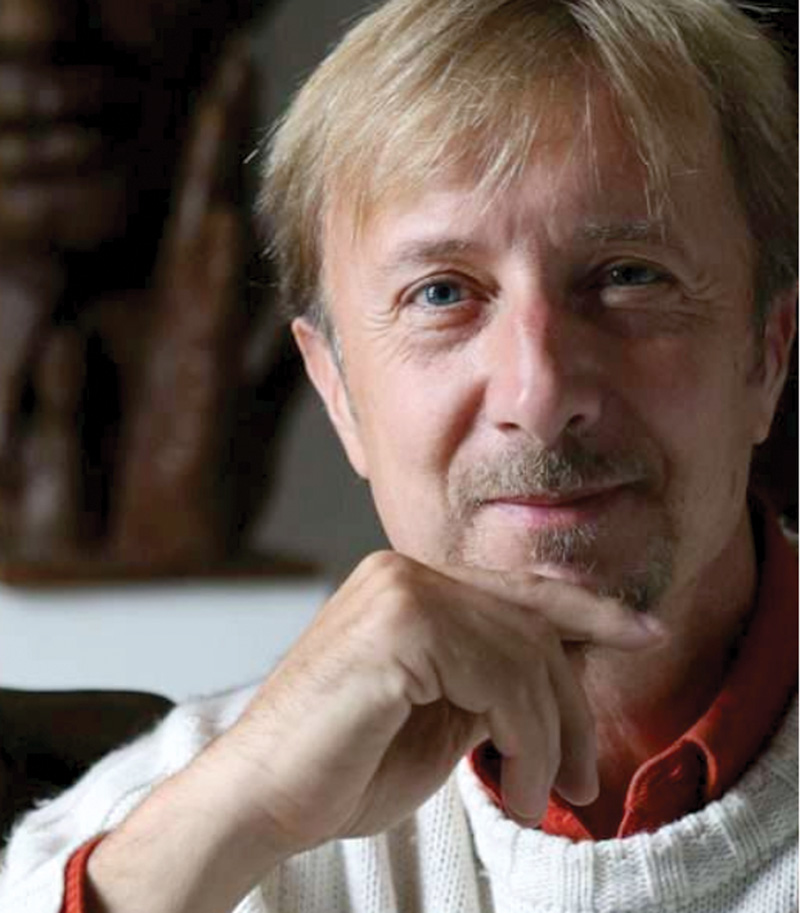
Paul Day, who has created grand public monuments throughout Europe, was thrilled to fashion a sculpture that reinforces the arts center’s mantra of “Arts for Every Life.”
“The arts provide shared emotional experiences for audiences,” says Day, thereby providing an antidote to the solitary immersion of the internet. In that way, he adds, the arts serve a purpose that no one would have anticipated a generation ago.
So Day was presold on the arts center’s mission. Soon, he would be equally enthused about the person whom he had been commissioned to commemorate: Jim Pugh.
Day, who is British with studios in Dijon, France, is one of the most acclaimed sculptors in the world. Among his early admirers was the Prince of Wales, now King Charles, who penned the introduction to a coffee-table book that celebrates the artist’s creations.
A portion of the introduction reads: “I have always been fascinated by the detail and the craftsmanship of [Day’s] work, and the deep respect he shows for the materials he uses, the history he portrays and the places where his work will be displayed. It seems to me that Paul Day’s work demonstrates all that is best of contemporary art, managing to be very much of its time but also somehow timeless.”
Among Day’s best-know sculptures is The Meeting Place, a 30-foot-tall bronze depiction of two passengers locked in a romantic embrace. It can be seen at St. Pancras International, a major rail hub in London.
He’s also known for Brussels: An Urban Comedy, an 82-footlong terracotta frieze depicting (in often humorous fashion) daily life in the European city. It can be seen at the Royal Galleries of Saint-Hubert in Brussels, Belgium.
Other large-scale works include The Battle of Britain Monument, a tribute to Royal Air Force pilots who fought in World War II, which can be seen in the Victoria Embankment Gardens in London, along with The Iraq and Afghanistan Memorial, a 20-foot-tall salute to veterans of wars in those countries.
Now underway is a tribute sculpture to Dame Vera Lynn along the White Cliffs of Dover, the region of English coastline facing the Strait of Dover and France. Lynn, who was known as “the sweetheart of the forces” during World War II, entertained soldiers around the world and became synonymous with such songs as “We’ll Meet Again.”
His first major American commission was 2019’s A Beautiful Day for a Neighbor, the statue of Fred Rogers, the beloved icon of children’s television, which is placed on the campus of Rollins College between Knowles Memorial Chapel and the Annie Russell Theatre.
A Wonderful Day for a Neighbor stands 7 feet tall and weighs more than 3,000 pounds. It depicts Rogers, seated, wearing his signature sweater and sneakers. On his hand is his best-known puppet, Daniel Striped Tiger, and he is surrounded by seven entranced children—including one in a wheelchair.
That project happened through a series of serendipitous occurrences, when developer Allan Keen, then chair of the college’s board of trustees, took note of Day’s work during a vacation to Europe and visited him at his studio.
Keen then conceived the idea of a monument to Rogers and raised private donations to commission Day for the project—the acclaim for which ultimately led to the sculptor’s work with the arts center.
Day studied at art schools Colchester and Dartington before completing his training in 1991 with a bachelor’s degree from the Cheltenham School of Art, now part of the University of Gloucestershire. (In 2006, he received an honorary doctorate from the institution.)
He now lives in a village near Dijon, France, with his wife, Catherine, who is also an artist. His studio is near their home. “I’ve always believed that my natural abilities are modest, but hard work and perseverance go a long way,” says Day. His natural abilities are clearly more than modest. But the part about hard work is without question true.
Adds Day: “I’m very disciplined, and I work long hours. I would say to aspiring artists, you should be in the studio every day and accept the mistakes you make until you get the results you’re looking for. Working diligently over the decades could get you there. Nothing happens by magic.”